

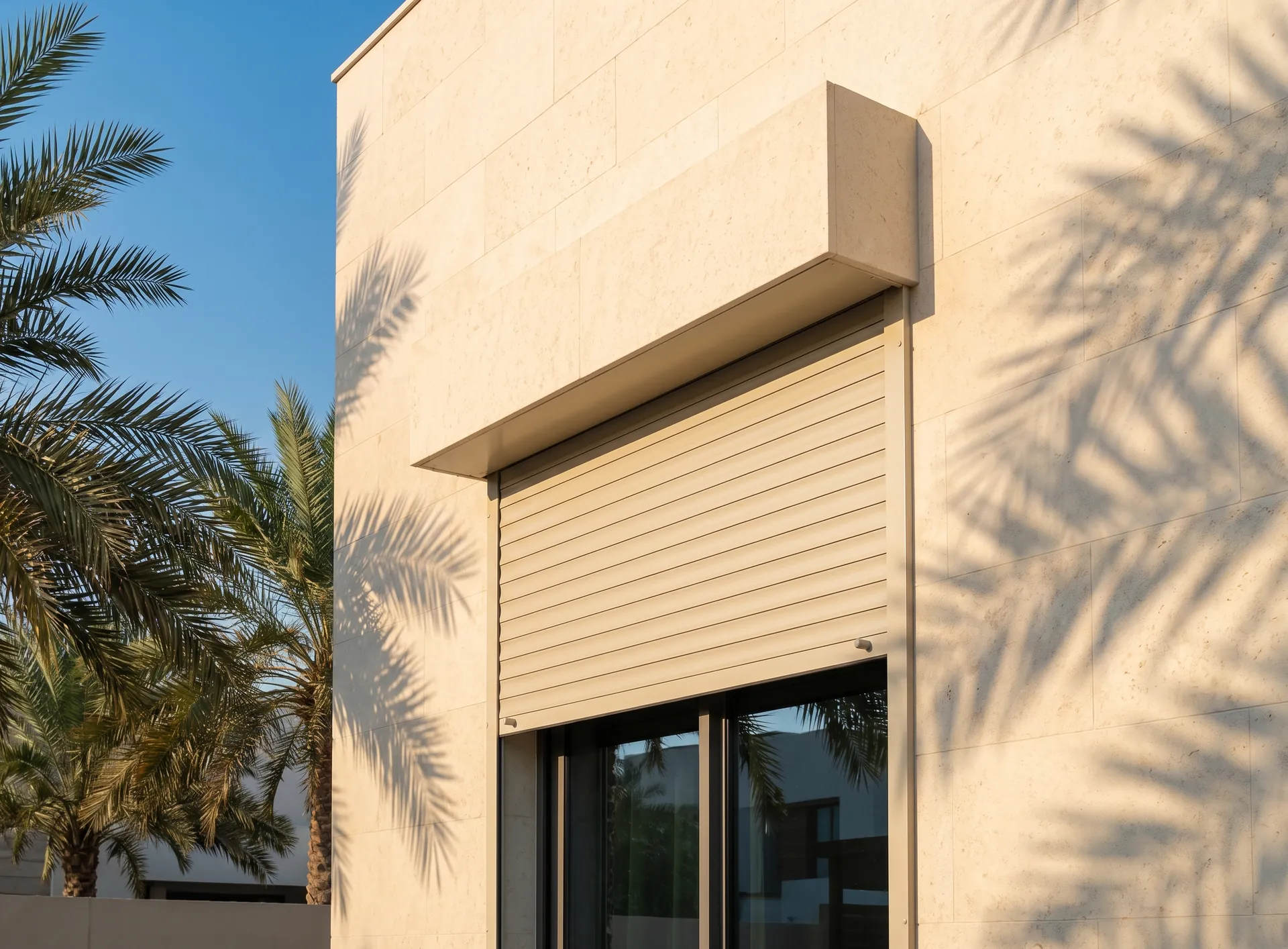
Roller shutters do three jobs at once here: they cut the sun before it reaches the glass, they add a physical barrier at ground level, and they keep blown dust off the window. Which of those matters most to you should decide the specification, because the shutter that shades a first-floor bedroom well is not the one that secures a villa's ground floor.
The slat: extruded or roll-formed
Roll-formed slats are made from thin aluminium strip formed into a hollow profile and usually filled with insulating foam. They are light, they are what most domestic shutters use, and they are perfectly adequate for shading and privacy. Their weakness is impact: a struck slat dents and stays dented.
Extruded slats are pushed through a die as solid sections, so they are thicker, heavier and considerably stronger. They cost more, they need a bigger box and a stronger motor to carry the weight, and they are what you specify when the shutter is doing security work rather than shading work.
The honest guidance is to match the slat to the job per opening rather than across the house. Roll-formed on the upper floors where the shutter is for sun and privacy; extruded at ground level and on any opening facing an unlit side of the plot.
Where the box goes, and why it is decided early
The rolled-up shutter has to live somewhere, and there are three answers. A built-in box sits inside the wall above the opening and is invisible when finished — the neatest result, and only available if the decision is made before the opening is built or during a substantial renovation.
A surface box is fixed to the facade above the window. It is the retrofit answer, it works well, and it is visible: it reads as a horizontal band across the top of the opening. On a villa where every window gets one, that band becomes part of the elevation, so it is worth looking at a photograph before agreeing.
The third is an integrated box built into the window frame itself, supplied as one unit with the window. This is the tidiest retrofit-adjacent option and it constrains the window: some of the opening height goes to the box, so the glass is shorter than it would otherwise be.
The box size is set by the slat and the height of the opening, because a taller shutter rolls into a bigger coil. A quote that promises a slim box on a tall window with heavy slats is worth questioning.
Manual or motorised
A manual shutter is operated by a crank handle through the wall or by a strap. It is cheaper, has nothing electrical to fail, and is genuinely fine on one or two windows. On a villa with a dozen openings, it becomes a chore that nobody does, and shutters that are never lowered are a wasted purchase.
Motorised shutters are the norm for anything above a couple of openings. The motor sits inside the roller tube, so nothing is visible, and control can be a wall switch, a handset, or the home system. The thing to insist on is a manual override — a way to raise the shutter without power — and to know where it is before you need it.
Sun-linked automation is the useful extra here. A shutter that lowers partway on a west elevation in the afternoon does its work without anyone remembering, and that is the difference between a shading system and a set of shutters that stay up.
What this climate does to them
Blown sand is the main enemy, and it collects in the guide rails at the sides. A shutter that grows noisy or stiff is almost always telling you the guides need clearing rather than that the motor is failing. Rinsing the rails through when you wash the windows is most of the maintenance this product needs.
Salt air is the second. Near the coast, the components to ask about are the fixings, the bearings at the ends of the roller tube, and the end caps. Stainless where it matters costs little at the order stage and is expensive to correct later, because the repair means taking the shutter apart.
Ultraviolet decides how the colour ages. Powder-coated aluminium holds up well; the parts that fade first are the plastic ones, so ask what the end caps and guide inserts are made of. This is a small detail that shows up clearly after a few summers on a south or west elevation.
Questions worth asking before you sign
What slat type and thickness, and why that one for this opening. What size box the finished assembly needs, and whether it is surface, built-in or integrated. Whether the motor has a manual override and where it is. What the guides and end caps are made of. And whether the quote includes making good the wall after fixing, which is a line that quietly appears later on some jobs.
One more, specific to apartments: check what your building permits. Many towers have rules about anything fixed to the facade, and a shutter box is very visible from outside. This is the same conversation as any external alteration, and it is better held before the order than after.
Decide the job first. If it is sun and privacy, roll-formed slats and a sensible box will do it for less. If it is security, specify extruded slats and accept the bigger box and stronger drive that come with them — a light shutter described as secure is neither.