Skip to content
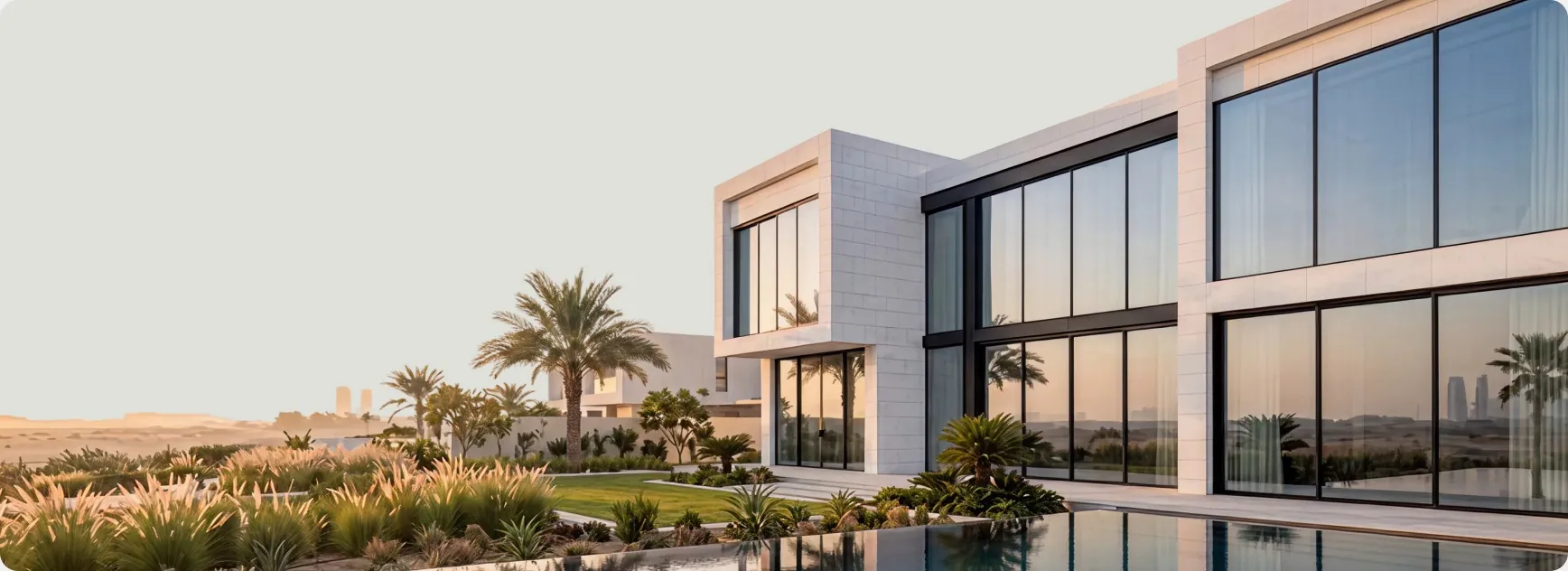
Panoramic aluminium windows of a modern Dubai villa seen from the garden at golden hour
  • ANSWERS
  • BY TOPIC

Questions and answers

The questions clients ask most often, collected from across the site and grouped by topic: what the price depends on, how the free measurement and the installation go, what the warranty covers, and how to choose between windows, doors, glass and finishes. If your question is not here, ask it in WhatsApp — we reply within 15 minutes during working hours.

  • 8 topics
  • 57 questions
  • 15 min reply in WhatsApp
Ask a question

Prices and payment

Because two windows that look identical in a photograph can differ by more than anyone can guess without measuring: a wider sash needs heavier hardware, a west-facing room needs a different glazing unit, and a flat with no service lift changes the installation entirely. We will happily talk the options through on the phone, but the number comes after the survey.

The survey visit, the measurements and the calculation are free and carry no obligation — you keep the drawing and the quotation whether or not you order. Work beyond that, such as a full facade study for a developer, is agreed separately before it starts.

Usually yes, by moving the money to where it does something. Splitting a very wide opening into a fixed pane plus a narrower opening sash, keeping shaded elevations at the glass minimum the Dubai Building Code sets for every facade and putting the stronger solar-control unit only where the sun lands, or standardising the hardware across a flat all show up in the total without changing how the window performs where it matters.

The quotation is written after the survey, so it should not. What can change it later is a decision you make — a different colour, a heavier glazing unit, an added insect screen — and each of those is re-priced against the same drawing before you approve it.

Into stages that match the work: an amount on signing that puts the order into the production schedule, an amount when fabrication is finished, and the balance at handover once the units are fitted and adjusted. The proportions are agreed for your order and written into the contract — we do not publish a fixed split, because a studio flat and a villa package are not the same job.

Yes, and that is the normal route for contractors and developers. The invoice carries our full trade details and matches the approved drawing position by position, which is exactly what a consultant or an accounts department will check it against.

Yes, for private orders. Card is most often used for the first stage at the office when the contract is signed; larger balances usually move by transfer, simply because of card limits rather than any preference of ours.

A change is priced as a variation against the approved drawing and signed before it is made. It is then folded into the remaining stages rather than settled on the side, so the contract and the invoices keep describing the same order.

Measurement, delivery and installation

Yes. The visit costs nothing and does not oblige you to order. It exists because a price given without it is a guess: photographs show what the window looks like, not whether the opening is square or what the frame will be fixed into.

From photos and rough sizes we can give a first orientation and answer questions — send them in WhatsApp. The price you can plan a budget on comes after the measurement, because only on site can the engineer see the wall, the fixings and the route for the frames.

Someone needs to open every room that is being glazed and answer a few questions about how the rooms are used — which sash should open where, what matters more in each room. The visit itself takes about as long as walking round the property with someone who keeps stopping to write.

Clear access to the windows, and in a tower or a gated community the name of the management office. If you already have architectural drawings or a fit-out plan, have them ready — they save questions later.

No. Openings are done one at a time so the home is never fully open, and floors and furniture are covered before the first frame comes out. In an occupied flat we plan the sequence around the rooms you need — bedrooms first, or the majlis last, whichever keeps the house usable.

That is decided at the survey rather than on the day. Where a unit fits the service lift it goes up the lift; where it does not, the crew uses stair-carrying frames or, for a wide pane high up a tower, a hoist or a rope access team arranged in advance with the building management.

We prepare what the building asks for — work permits, crew passes, agreed timings and any other documents the management requests — and submit them before the delivery is booked. Most towers restrict working hours and lift use, and the schedule is built around those rules rather than against them.

Nothing but the windows. Old frames, packaging, offcuts and sealant waste leave with the crew, and the glass and frames are cleaned before handover. Anything spotted during the walk-round is written down and closed before the job is signed off.

Warranty and service

Contact us with the address and photographs of what is happening, and say when it started. Your file holds the drawing and the installation report, so in most cases we can tell before the visit whether this is an adjustment, a gasket or a glazing unit — which decides what the technician brings with him.

On top of our own warranty on fabrication and installation, the profile system itself carries the manufacturer's warranty — up to 20 years, depending on the system chosen. That covers the aluminium profile, not the whole window: glazing units, hardware and the fitting sit under our warranty, and its written terms come with the contract before fabrication starts.

Condensation between the panes means the sealed unit has failed, and that is a warranty matter. Condensation on the outside of the glass or on the room side is a different thing entirely: humid outdoor air meeting glass cooled by the air conditioning, or steam indoors with too little ventilation. Replacing the unit will not stop it, so we look at the cause before touching the glass.

It affects what is fair to claim. Hardware and gaskets in this climate need cleaning: sand collects in the drainage channels and along the seal line, and a sash that has been grinding against grit for a season is wear rather than a defect. Rinsing the frames and clearing the drainage keeps both the window and the cover intact.

As a rule, no. We service the systems we manufacture, where the parts are known. For other brands we refer you to windowrepair.ae, the repair company in the same group.

No, and nothing applied to either face will reach it. Misting means the perimeter seal of the sealed unit has failed and moisture is now inside the cavity. The unit itself is remade and exchanged, while the frame, the hardware and the finish stay in place.

Less time than the profile does. Direct sun and a summer design temperature of 46°C, with peaks above 50°C, age rubber faster than a temperate climate, and the south- and west-facing elevations go first, so the same building can need one facade done and not another. On a service visit the gaskets are checked and replaced by condition rather than by a date.

It can be discussed. A maintenance agreement for the whole property would set the visit schedule and the response time in writing; without one, visits are arranged job by job.

Windows

Tilt-and-turn, in most cases. The tilt position ventilates without opening the sash into the room, and the full turn lets you clean the outer pane from inside. In an apartment building the Dubai Building Code 2021 (E.9.4) adds a condition: where the sill is lower than 900 mm, the sash may open no more than 100 mm, so it is fitted with a restrictor. It is then opened fully for cleaning with a key, and only where the building's rules allow it. Sill heights are checked at the survey.

Not with a thermal break. The break is a polyamide bar inside the profile that stops heat travelling through the metal; combined with a solar-control unit it is the glass, not the frame, that governs how much heat reaches the room.

It depends on the system and the wind load at your height. On our standard systems a single fixed pane runs to roughly 3 by 4 metres; beyond that we split the opening or move to a facade system, which the structural calculation decides.

Three to five weeks for a standard order, counted from the approved drawing. Non-standard shapes and imported profile systems add to that, and we state the date in the quote rather than after the deposit.
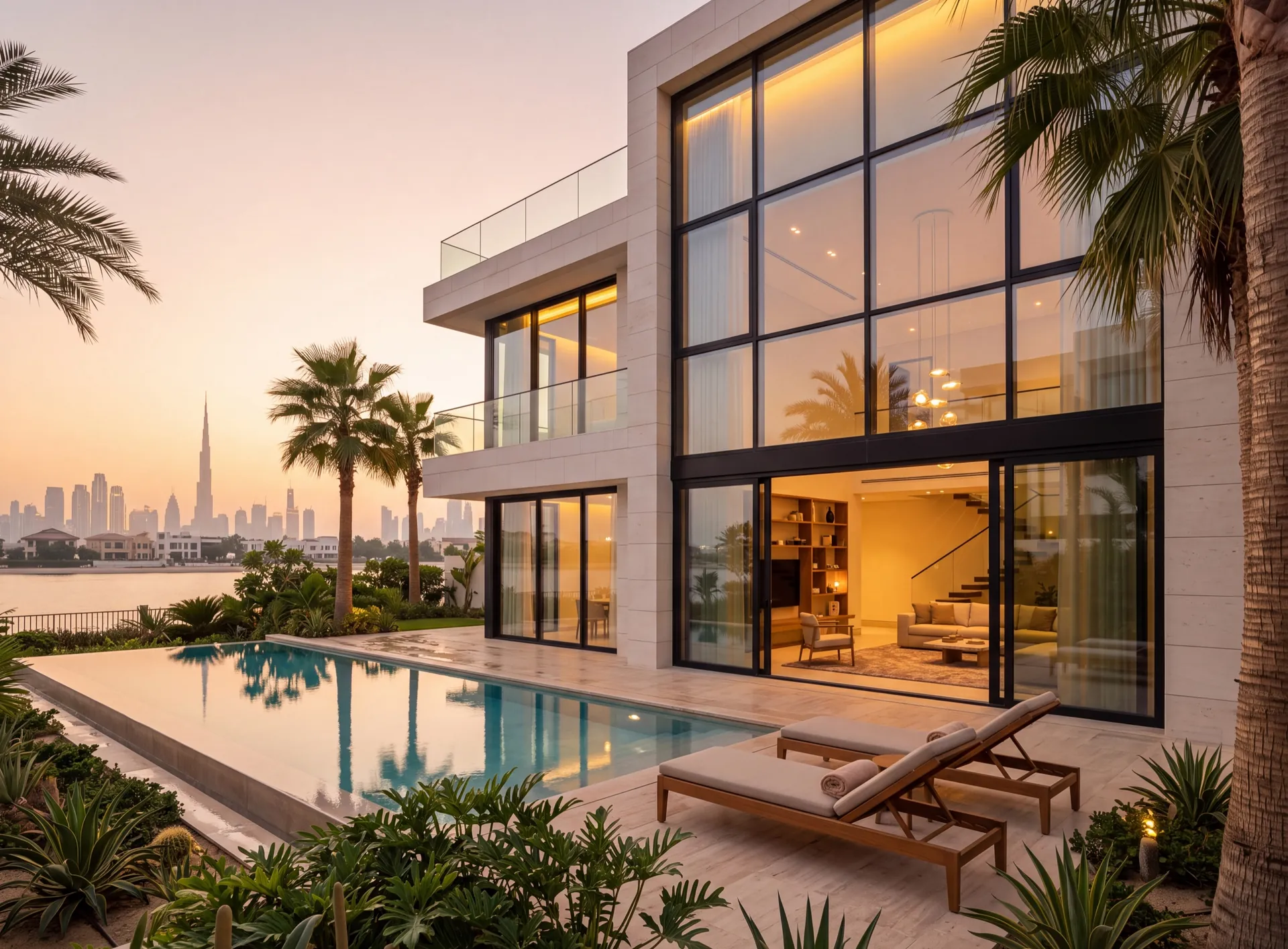
Modern villa with panoramic aluminium glazing and a pool at sunset

Ask your question

Leave your name and number and write the question in WhatsApp if it's easier. We reply within 15 minutes during working hours, Mon–Fri 9:00–18:00.

Doors

On a two-track door, about half of it: one leaf parks behind the other and both stay inside the frame. Three and four-track arrangements stack more leaves to one side and clear proportionally more, at the cost of a deeper frame at the head and the sill. If the brief is a genuinely empty opening — a whole living-room wall gone — the honest answer is a folding door or a pocket, not another track.

The handle drives a gear along the bottom of the leaf. In the closed position the leaf rests low, squeezed down onto a gasket that runs the full length of the sill, and the carriages carry nothing. Turning the handle rotates cams that push against the track and lift the leaf a small amount — enough to break contact with the seal and transfer the weight onto the bogies. From that moment the leaf rolls. Turning the handle back reverses it, and the leaf settles onto the gasket under its own mass.

Almost. The leaves fold flat against each other and roll to one end, so what remains in the opening is the stack itself standing side-on to the glass line, plus the frame. Folding the pack outward puts it beyond the wall entirely; folding it inward leaves it inside the room. Either way you lose the thickness of the pack, not half the opening — which is the difference between this and a slider.

Security comes from the lock case, the cylinder and the number of points the leaf latches at — not from what the frame is made of. An aluminium frame carries a multi-point lock and a reinforced keep exactly as a steel one does, and it will not swell in UAE humidity, so the lock keeps meeting its strike plate season after season.

Larger than anything you would hang on hinges, because the constraint changes. A hinged leaf is limited by what the jamb and its fixings will take in shear; a pivot leaf sits on a bearing in the floor, so the question becomes the capacity of that box, the stiffness of the leaf itself against twisting, and whether the slab beneath it is sound. We size all three from the leaf you actually want rather than offering a catalogue maximum.

Two things, and they are about intention as much as ironmongery. A French pair is fully glazed and symmetrical — both leaves are the same width, both are meant to be opened, and the design exists to put light and a garden into a room. A general double door is usually a wide leaf you use and a narrow one you unbolt when the sofa arrives. The hardware overlaps, the purpose does not, and that difference drives everything from the leaf widths to where the handles sit.

Glazing, pergolas and soundproofing

The open timber-style grid that people picture first is the weakest answer here, because for most of the day the sun is high and drops almost straight through it. The real choice is between a solid deck, which gives one deep shadow from morning to evening, and turning blades, which let you decide how much light and how much moving air you want at any hour. Gardens used mainly at midday tend towards the solid deck; terraces used in the evening tend towards blades.

Yes. In Emaar and Dubai Holding communities (Nakheel, Meraas, Dubai Properties) written approval (an NOC) always comes before work, and elsewhere the community rather than the design decides how strict it is. Master developments and owners associations vary in what they allow along a boundary, what height they permit and what finishes they accept, so we issue a drawing showing the footprint, the height and the fixings, and the structure is built to whatever comes back approved. Where a submission is needed we can prepare it; what we do not do is quote a rule number we have not read.

Hot enough that it changes what we specify. A dark powder coat on a beam facing straight up absorbs a great deal, and although the frame is not what you touch most of the day, the handles, the post faces beside a seat and the underside of the roof all are. Lighter finishes on the horizontal surfaces, a lined or insulated soffit and handles placed out of the sun make more difference to how the space feels than another section size would.

Most likely nothing went wrong with the glass. An opening behaves like a chain, and once one link is far worse than the rest it sets the result on its own — the new unit simply cannot be heard over it. The usual culprits are the joint between frame and wall, which is often hollow behind the trim, the ventilation penetration cut through the wall beside the window, and the door into the room. Improving the pane while any of those stands open is like fixing a fence and leaving the gate off.

Much of it, yes. Gaskets, hardware adjustment, a door set, a drop threshold and a second inner frame all go in with the walls left alone. What cannot be done quietly is the perimeter joint on a badly built opening: to pack it properly the trim comes off and the gap gets filled through its depth, which means dust and making good afterwards. We say which of the two you are looking at during the survey rather than after the invoice.

In words, and about specific things. We say what stops being audible: whether you can still make out words through the wall, whether the lift doors and the trolley in the corridor register, whether traffic reads as separate vehicles or as one distant band of sound. That description is honest and it is checkable by you, standing in your own room. Where a contract genuinely needs a measured result — a studio, a fitted-out office handover — that measurement is an acoustic consultant's work, and we build to the target they set.

Glass, colours and options

Double, in almost every case. The second pane and the sealed cavity do the work here. A third pane is aimed at sub-zero winters: it adds weight, thickness and a heavier sash for very little where the problem is sunlight rather than frost. In this climate you change the coating on the glass instead of adding another pane.

No. Film is applied to the room side of glass you already own, where every cloth and squeegee reaches it; Dubai Municipality accepts films certified by Dubai Central Laboratory (DCL), so a good one is a fair retrofit. A solar-control coating is laid on the pane at the glass works: most today are sputtered soft coats, sealed inside the unit facing the cavity, and only pyrolytic hard coats are baked into the surface. Tint mainly darkens the view; the coating filters the heat and leaves the room bright.

It will cut it, not remove it. Sound takes the weakest path, so an acoustic unit only pays off when the frame and the seals are tight as well. We look at what is around the building first: a motorway, a construction site or a flight path. Road and aircraft noise are rated by the same figure, Rw + Ctr, which weights the low frequencies that are hardest to stop, so the pane combination is chosen for how loud the source is at your window. And we say plainly when the noise is arriving through the wall or the air-conditioning opening rather than the window.

You see it before you measure it: mist or droplets appear between the panes and no amount of cleaning removes them, because the edge seal has failed and humid outside air is now inside the cavity. That unit is replaced, not repaired. Because the units are assembled in our own Dubai factory, a replacement is remade to the same sizes from the drawing on file. The warranty terms for the specified glass and spacer are written into the quote.

Both finishes are made for it, but they age differently. A powder coat is a paint layer: on an exposed west elevation it chalks slowly, and it can be recoated. Anodising is an oxide grown into the metal itself, so there is no film to lift — the usual choice within a kilometre of the water. We pick the coating class by how exposed the elevation is rather than by what is cheapest on the line.

On powder-coated profiles, yes — the RAL range plus matt, textured and metallic variants, and a different colour inside and out on most systems. Two things are worth knowing. A colour we do not hold means a dedicated coating run, which is allowed for in the dates on the quote rather than sprung on you later. And a printed chart or a monitor is not a colour match: ask for a sprayed sample and look at it on the building in daylight before the drawing is signed.

They hold back insects and the coarse airborne grit. The fine dust that a shamal carries will pass through any mesh you can still see through, so treat a screen as a ventilation option, not a dust filter. What it reliably buys you is open windows on spring and autumn nights without the garden coming in. For screens we refer you to our sister brand Mosquito Nets UAE; measured with the window, their frames line up.

It earns its place in two situations: sashes nobody can reach — high-level vents, atrium and stairwell glazing — and openings that have to answer to something else, a rain sensor or a smoke extraction line. For an ordinary window at arm's length a good handle does the same job for less. Either way the decision belongs before manufacture: an actuator needs a power feed inside the reveal and reinforcement in the sash.

Showroom, factory and documents

Call before you come and we will have the right specialist and the right samples out. Visits are by arrangement rather than walk-in, mainly because the engineers who can answer profile and glazing questions properly are often out on surveys.

Please do. A floor tile, a door handle, a kitchen front or a paint chip settles a colour argument faster than any digital swatch, because powder coating and anodising read differently under showroom light than they do on a screen.

No. The showroom and the office are in The Pinnacle Building on Sheikh Zayed Road; the units themselves are made at our own factory in the UAE. Samples, drawings, the quotation and the contract all happen at the showroom — that is the one address you need.

No, and realistically nobody fabricating windows does. Profile systems are bought from their manufacturers together with the gaskets, thermal bars and hardware they were designed around. What we make is the window: cutting, corner crimping, drainage, glazing, hanging and sealing all happen in our Dubai workshop.

No, and we would rather say so than imply otherwise. We fabricate with the systems we buy and we name the system in the drawing. A licence would change the sticker on the profile, not the way a unit is cut, glazed and adjusted — and that part is ours to get right.

It changes the cost structure rather than simply adding to it: the local Gulfex profile comes with no freight, container or customs step in the middle of your schedule. Imported systems, such as Cortizo from Spain, take longer to arrive, and their lead time is stated in the quote. Either way the price follows the profile system, the glazing make-up and the hardware, which is why we quote from a drawing and not from a list.

Yes. Tell us which system and which coating your quotation is based on and we will send the documents that cover them. We deliberately keep certificate numbers off this page: they are tied to a specific system, colour and batch, and a number that does not match your order is worse than no number at all.

The powder maker's technical data for the exact product and colour on your order: its weathering class and how the finish should be cleaned. It says nothing about the window itself, which is why it sits alongside the profile system's own documents rather than replacing them.

The glass supplier issues them and we pass them on, with the make-up written into your drawing: the coating, the spacer and the cavity. That way the declaration and the unit that was actually fitted describe the same thing.

We are always happy to welcome you at our showroom

Main Office

Dubai — Showroom

The Pinnacle Building, Sheikh Zayed Road, Office 607

Mon–Fri: 9:00 – 18:00
+971 50 220 6913

Showroom

Samples to see in person

Profiles, glass units and hardware to see and touch before you choose.

Dubai — Showroom The Pinnacle Building, Sheikh Zayed Road, Office 607
Get directions