


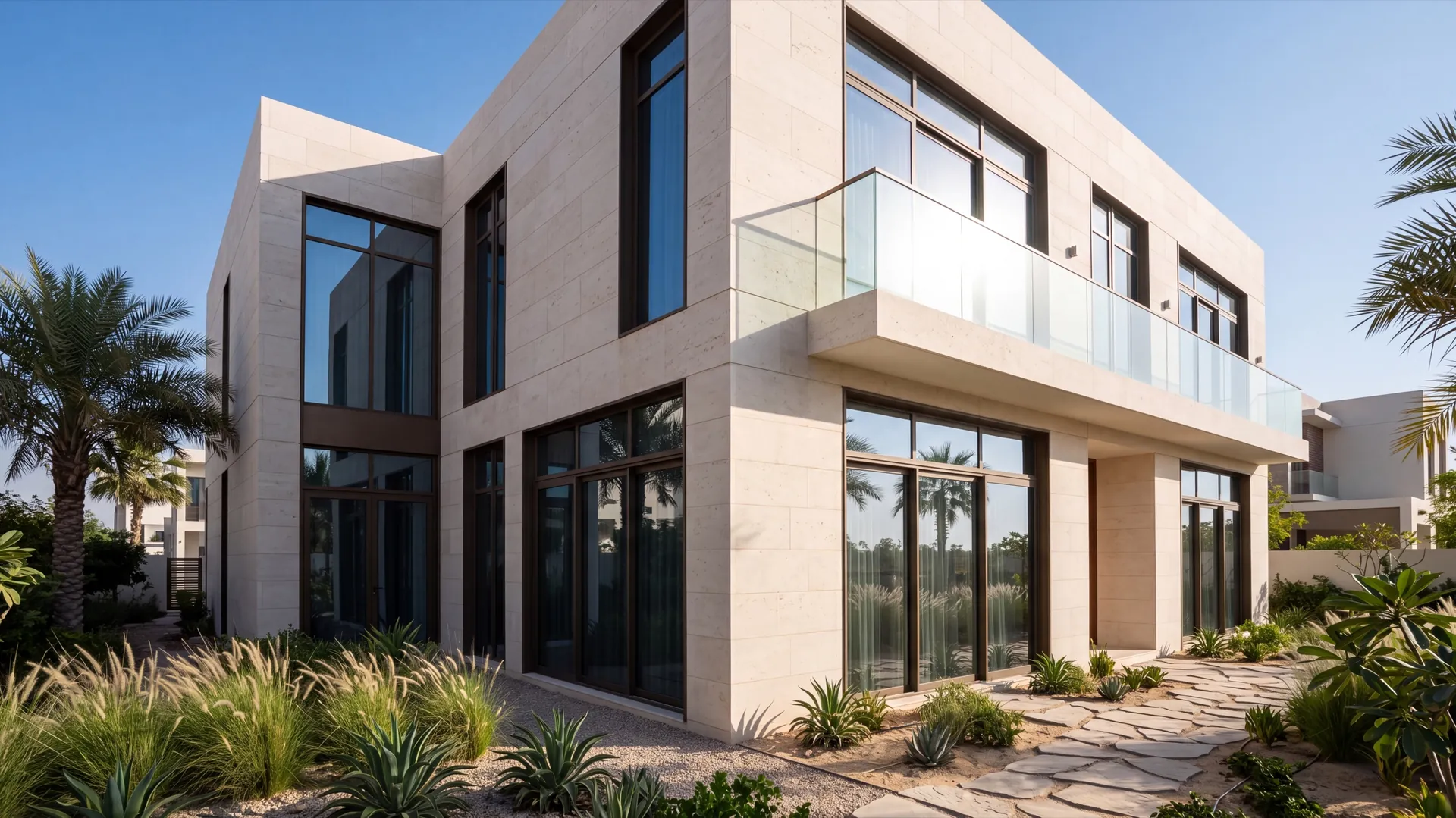
A room that is uncomfortable at four in the afternoon and perfectly pleasant at midnight has a sunlight problem, not an insulation problem. Almost everything that matters about glazing in this country follows from that one observation, and it is the reason advice written for a European winter leads people to spend on the wrong half of the window.
Where the heat actually gets into the room
Through the glass, as sunlight. The pane is most of the area of a window and the frame is a border around it, and sunlight landing on a floor, a sofa or a wall becomes heat in the room the instant it arrives. Heat conducted through the metal of the frame and warm air leaking past a tired seal are real, and they come second and third — not first.
That order is the reverse of the one most window literature is built on. In a cold market the enemy is warmth escaping, the temperature difference across the window does the damage, and the frame is a large share of the loss. Here the sun does the damage while it is shining, and it stops doing it the moment the sun goes round the corner of the building.
The practical consequence is blunt: spend on the glass first. A modest frame carrying the right sealed unit will beat an expensive frame carrying plain glass on a sunlit elevation, and it will beat it on the afternoon a west-facing living room is at its worst.
What a coating on the pane is doing
Sunlight arrives as two things at once — the light you want in the room and the infrared you do not. A selective coating is a layer of metal oxide on the pane, far too thin to see, that lets the visible part through and turns the infrared part back outside before it can become heat indoors. The room stays bright and the cooling has less to argue with; that is the whole trick, and there is nothing else in a window that does it.
You can usually tell whether the glass you already have carries one. In a dark room, hold a small flame or a phone torch at an angle to the pane and count the reflections: a sealed unit gives you four. On a coated unit one of those four sits at a noticeably different colour from the others. Four matching reflections in an older villa means nobody paid for a coating, whatever the handover file says.
Where the coating sits matters as much as whether it is there. Most solar-control coatings today are sputtered soft coats on a face inside the sealed cavity, so no cloth and no cleaner ever reaches them; only the harder pyrolytic coats are baked into the surface. Either way the coating is applied at the glass works, which is the reason it cannot be added to glass that is already in the wall. Film can be stuck on afterwards, and Dubai Municipality accepts films certified by Dubai Central Laboratory (DCL), but film sits on the room side, where every cloth and squeegee reaches it.
The compass decides more than the chamber count
Ask which way a window faces before asking how many chambers are in the profile. West is the punishing elevation in a Dubai summer: the low afternoon sun comes in almost horizontally, ducks under the balcony that was supposed to shade it and goes straight through the glass. South carries the sun for most of the day. East warms early and then lets go by lunchtime. North sees sky rather than sun. It still has to meet the glass limits the Dubai Building Code sets for every elevation, but above that minimum it can usually be glazed more simply.
Triple glazing and extra air gaps answer a different question. They work on the temperature difference across the window, which a northern winter supplies in abundance, while in a UAE summer most of the load is the sun itself. Radiation landing on a pane is barely troubled by another layer of still air, so a third pane here buys weight on the hinges, depth in the frame and a heavier sash to swing, in exchange for a gain the room does not notice.
So a villa is rarely glazed the same on all four sides. Every opening meets the code minimum; the west and south openings take the harder-working unit on top of it, the north ones usually stay at it, and what is saved there is what pays for the west. A quotation that puts an identical unit on every opening in the building has not looked at the building.
What the thermal break does, and what it does not
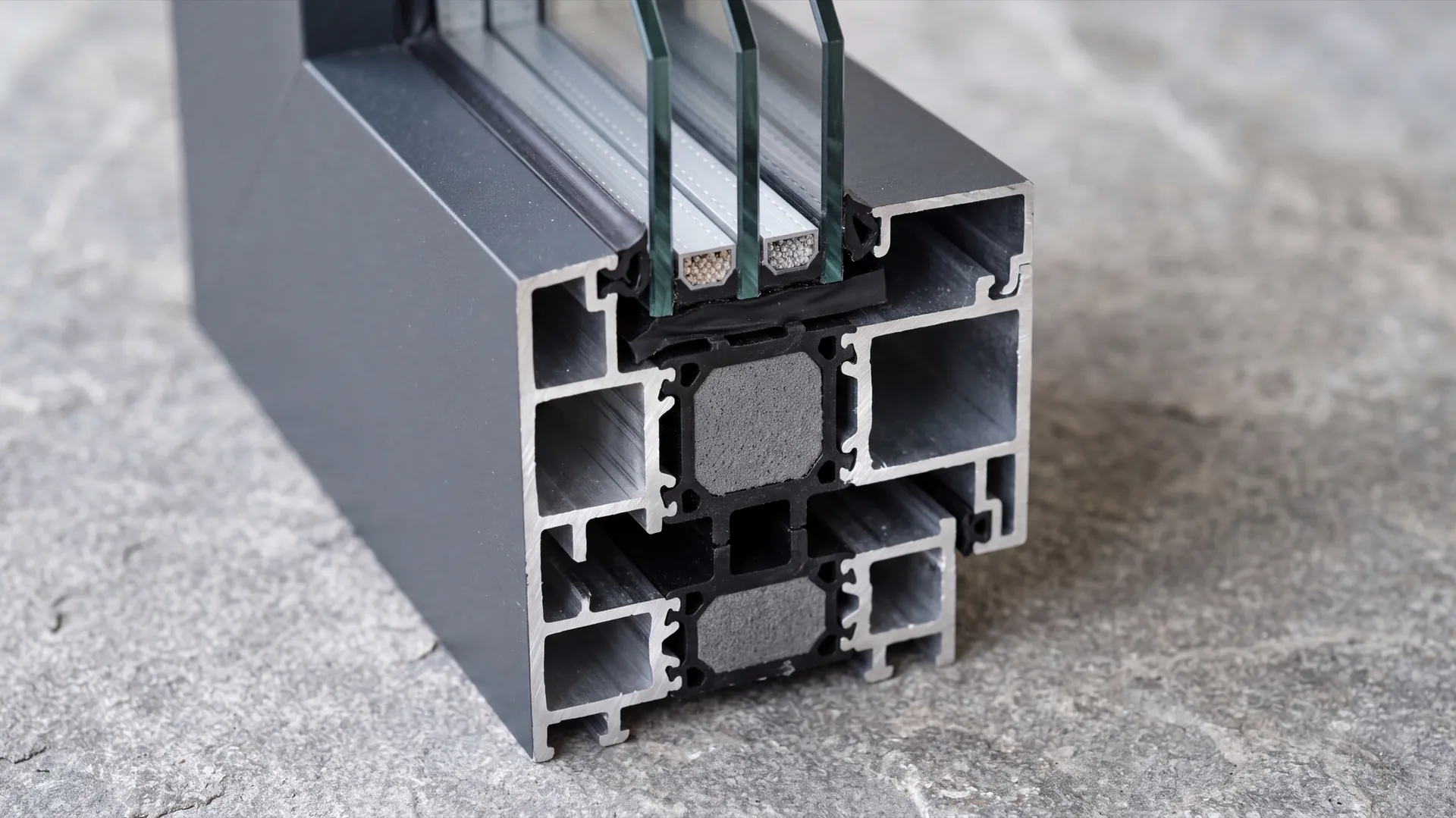
It stops the frame being a shortcut. Aluminium moves heat readily, so a single-piece profile runs unbroken metal from the face baking outside to the face inside the cooled room. A thermal break is an insulating bar set between the outer and inner halves of the section, and it interrupts that path — which is why the same window in a broken and an unbroken version behaves like two different products in August.
What you notice is less the bill than the frame itself. An unbroken profile in an air-conditioned flat runs cold through the whole section in the humid months and collects water where that cold meets damp air; a broken one keeps its two halves at their own temperatures and stays dry. The same reasoning applies at the edge of the glazing unit, where a warm-edge spacer replaces a conducting one.
It is not, however, a stand-in for the glass. The break stops heat crossing the metal; it does nothing whatever about sunlight crossing the pane. A beautifully broken frame around uncoated glass on a west elevation will still cook the room, and it will do it while the specification looks impressive on paper.
When changing only the glass is enough
When the frames are sound and the complaint is heat rather than dust or air getting in. If the sashes still close and lock properly, the gaskets are supple, nothing rattles and no dust arrives on the sill after a shamal, the sealed unit can be exchanged inside the frame already on the wall. It is a shorter, cheaper and far less disruptive job than replacing the window, and on a tower it avoids a scaffold conversation with the building management altogether.
The limit is the profile. Every system has a fixed glazing rebate, so the replacement has to suit the depth the frame was drawn around, and a thicker build-up that pairs a coating with a laminated pane will not always go in. That gets measured against your actual frame at the survey rather than promised over the phone, and an engineer can be with you within 48 hours to settle it.
Where a swap is not enough is the older villa stock: single glazing in an unbroken frame with gaskets that went hard several summers ago. Changing the glass there fixes one of three problems and leaves a window that still conducts and still leaks. The honest answer in that case is a new window, and it is worth hearing before the deposit rather than after the first bill.
Glass first, elevation second, frame third — and the order set by where the heat is actually coming from rather than by whichever line the brochure prints in bold. Most of the money in a glazing job either lands on the sunlit sides of the building or it does not, and that single choice separates a flat that holds its temperature from one that spends every afternoon losing an argument with the window.