


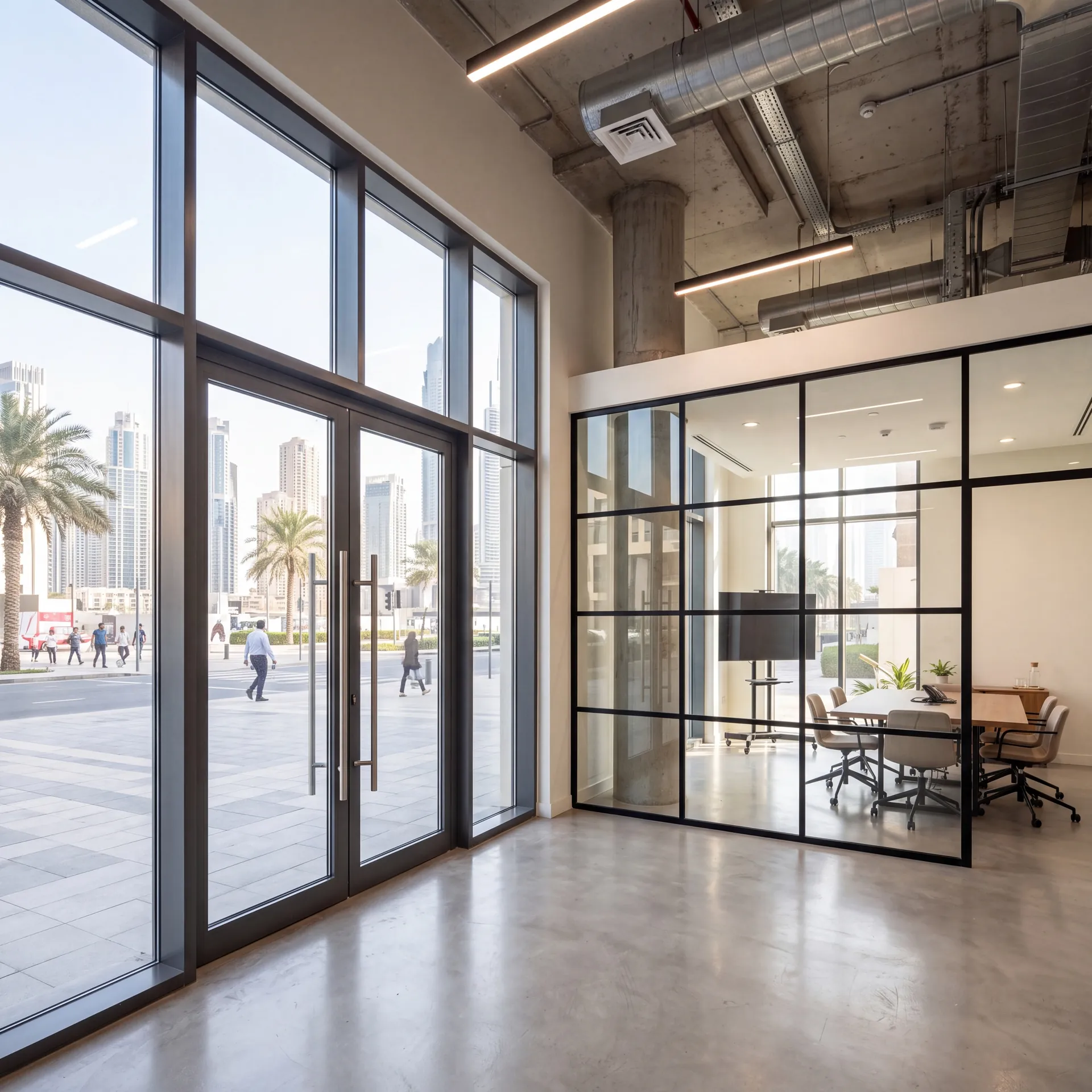
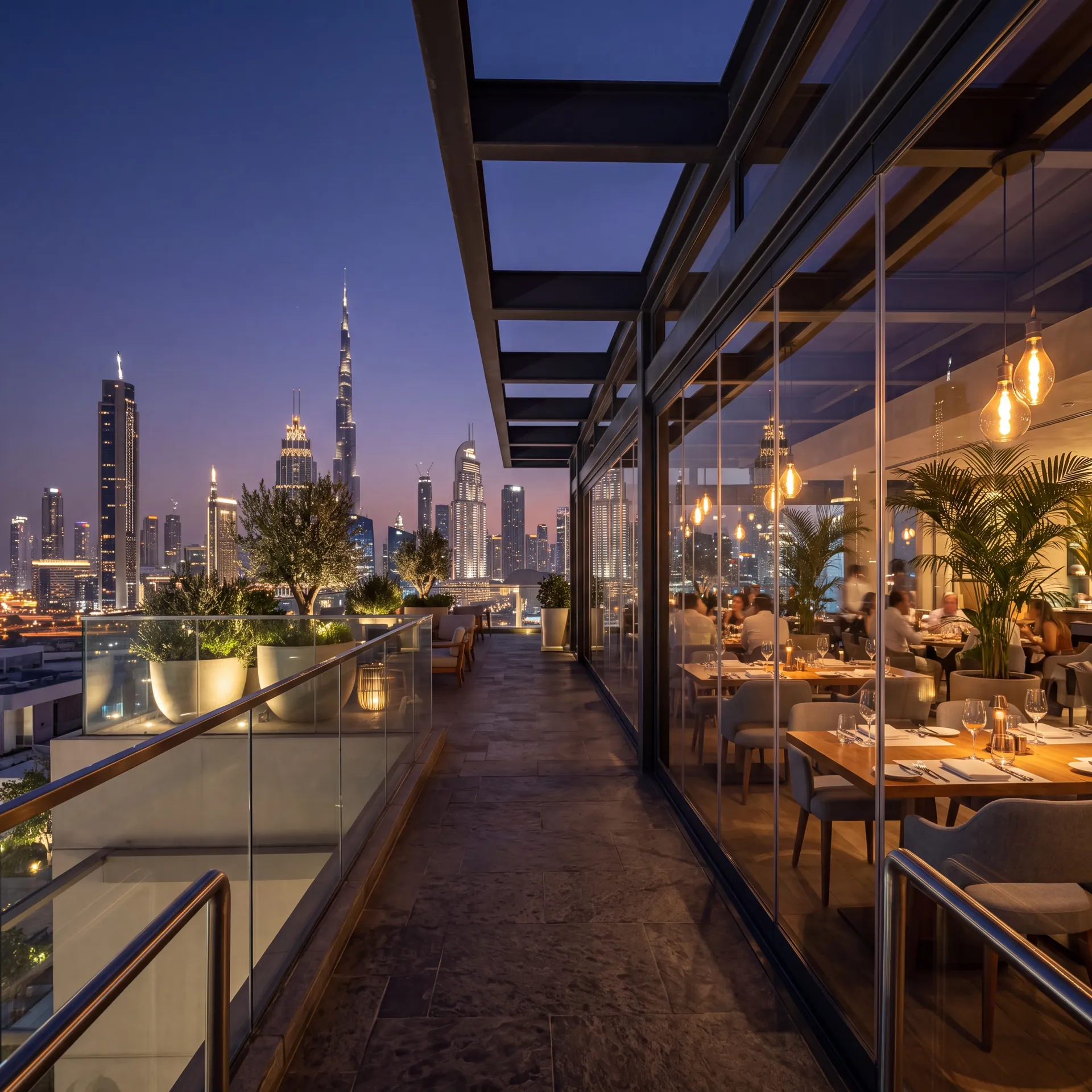
Main Office

Dubai — Showroom
The Pinnacle Building, Sheikh Zayed Road, Office 607
Mon–Fri: 9:00 – 18:00
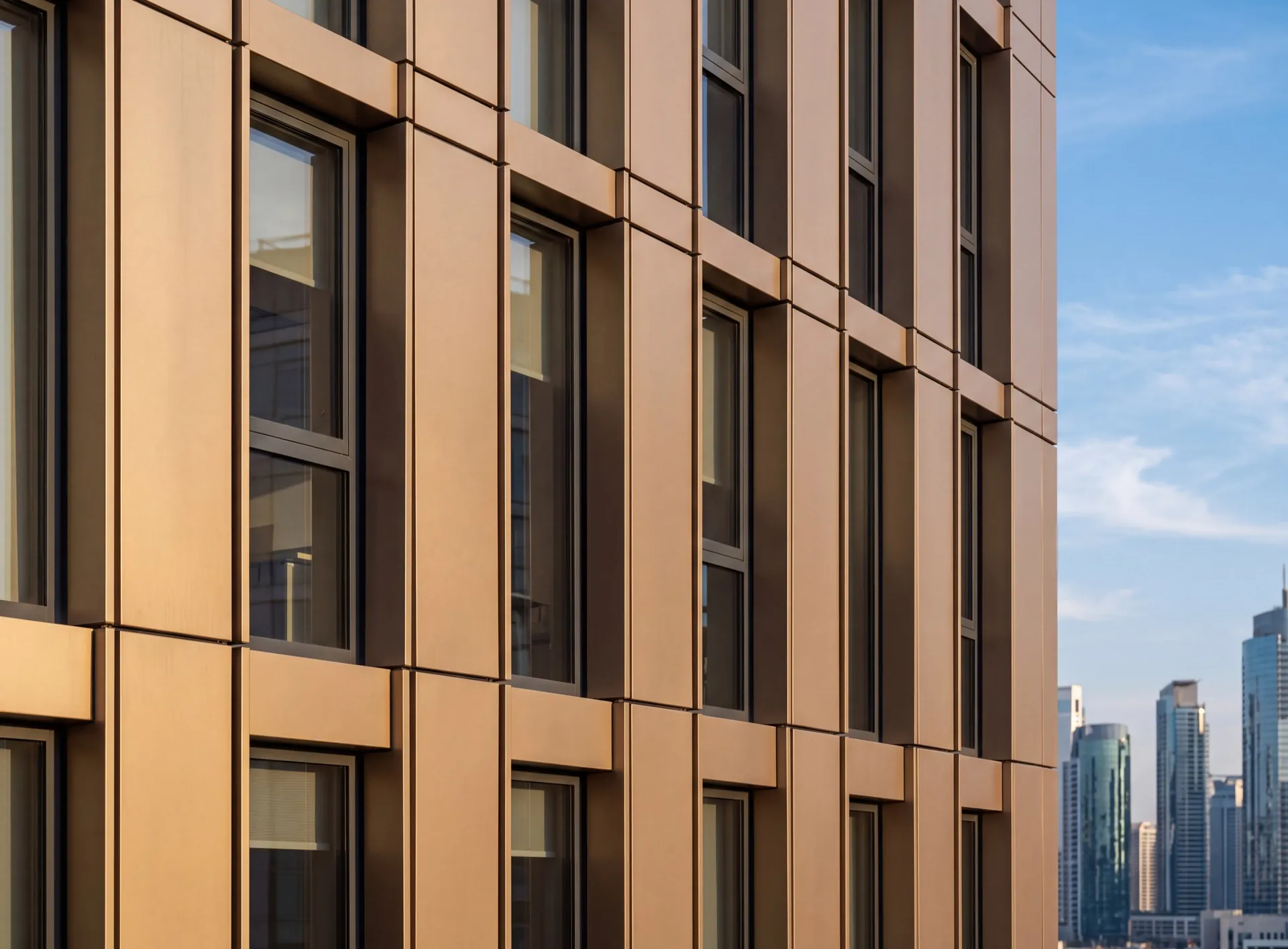
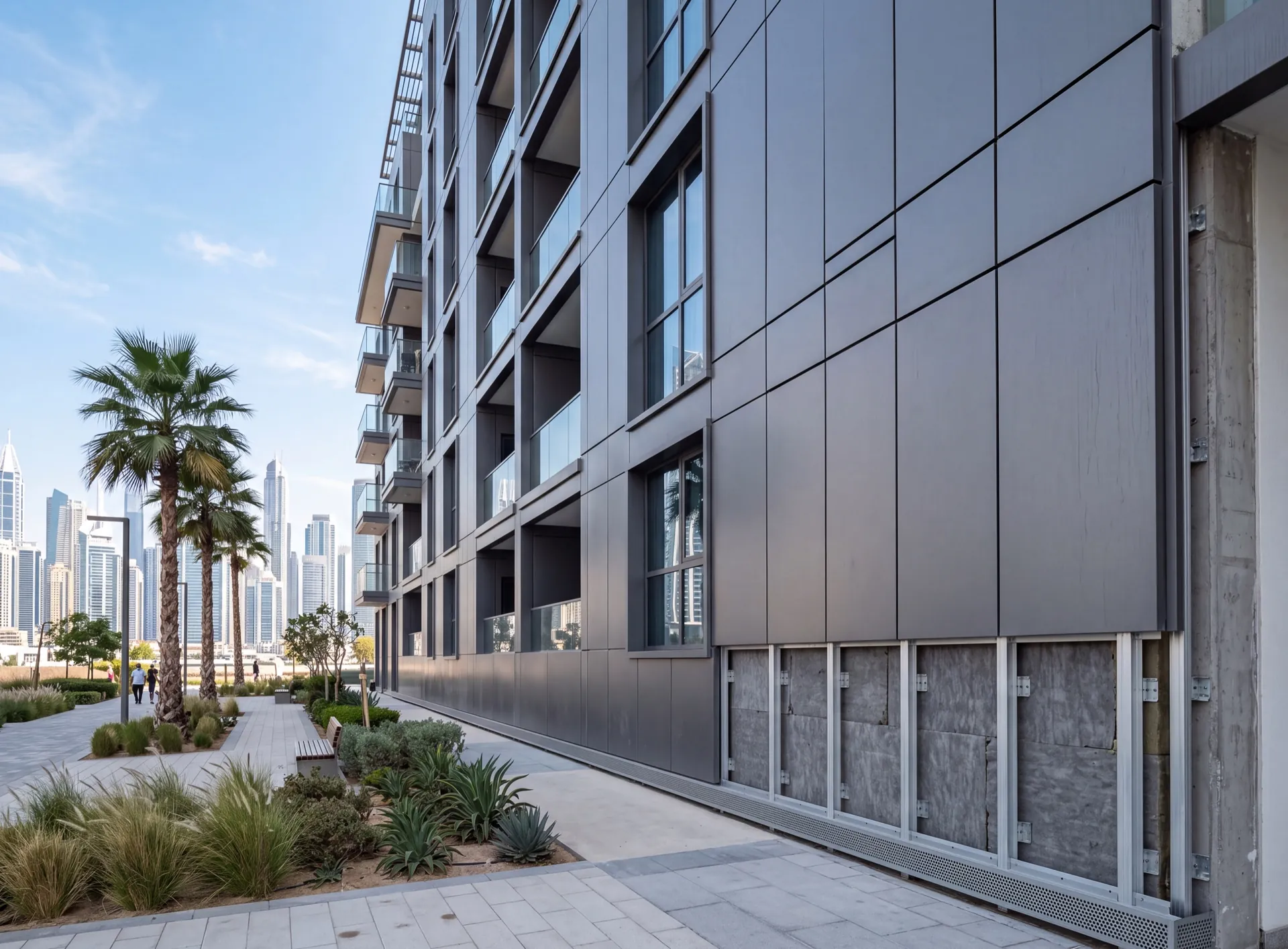
A cassette is a sheet of aluminium folded back on all four edges into a shallow tray. The folds are what make it rigid, so the panel needs no visible fixing across its face: it is hung from clips on rails behind it and located by them, with a deliberate gap left between one tray and the next. Two things follow from that, and they are the reasons a cassette elevation is specified rather than a flat sheet. The hanger takes up what the structure got wrong, so a wall that is out of true still produces straight shadow lines. And because each tray is only held by its own clips, one damaged panel comes off on its own and a replacement goes back in its place.
Powder coating in any shade of the RAL palette; the colour is confirmed against a physical sample at the survey.
Anodising builds an oxide layer on the profile itself, so the colour belongs to the metal rather than to a film on top of it and cannot peel.
Wood-grain and stone-effect finishes are transferred onto the powder coating. The profile keeps the strength of aluminium and never needs repainting.
Available colours (200+ RAL shades)
Anodised finishes
Wood-grain and special effects
Folded returns
Tray
The panel stiffens itself
Nothing on the face
Fixing
Clips are hidden behind the fold
Left open
Joint
A drawn line, not a sealed one
Taken at the clip
Tolerance
Walls are rarely exactly as drawn
Proportion and gauge
Flatness
What keeps a wide face from rippling
Get a free calculation for your windows — just leave your number, we'll reply on WhatsApp within 15 minutes.
Made to size in our own factory in Dubai — in 3–5 weeks.
Pricing
Choose the options — we’ll send the price on WhatsApp
What are we making
Shape and opening
Size
Width and height: 300–6000 mm. Not sure? Clear the fields — we’ll measure at the free survey.
Width under 300 mm — check that it is in millimetres.
Width over 6000 mm — we’ll confirm it at the survey.
Height under 300 mm — check that it is in millimetres.
Height over 6000 mm — we’ll confirm it at the survey.
Enter a whole number of units, 1 or more.
Glazing unit
Extras
Do you need a windowsill?
Do you need a coloured profile?
Do you need installation?
The honest downside
A cassette elevation is a finish, not insulation. The trays change how the building looks; what keeps heat off the wall is the cavity and the insulation behind them, so re-cladding in cassettes alone will not make the rooms any cooler.
The open joints have a cost too. They show whatever sits behind them, so the backing has to be dark and tidy, and blown sand and dust get into the cavity. At ground level a folded tray also dents where trolleys, cars and footballs meet it, and a replacement made years later can read newer than its sun-faded neighbours.
If the aim is a cooler building rather than a new face, start with the ventilated cavity and choose the skin afterwards. Cassettes are the right answer where the elevation must read crisply, hide its fixings and let one damaged panel come off on its own.
 Consider instead
Ventilated facades
Consider instead
Ventilated facades
Nearby pages and the rest of the catalogue.
Sections
Company
The Pinnacle Building, Sheikh Zayed Road, Office 607
Mon–Fri: 9:00 – 18:00

Profiles, glass units and hardware to see and touch before you choose.

Free measurement
Leave your number — we call back to agree a time that suits you.
We reply within 15 minutes during working hours.