

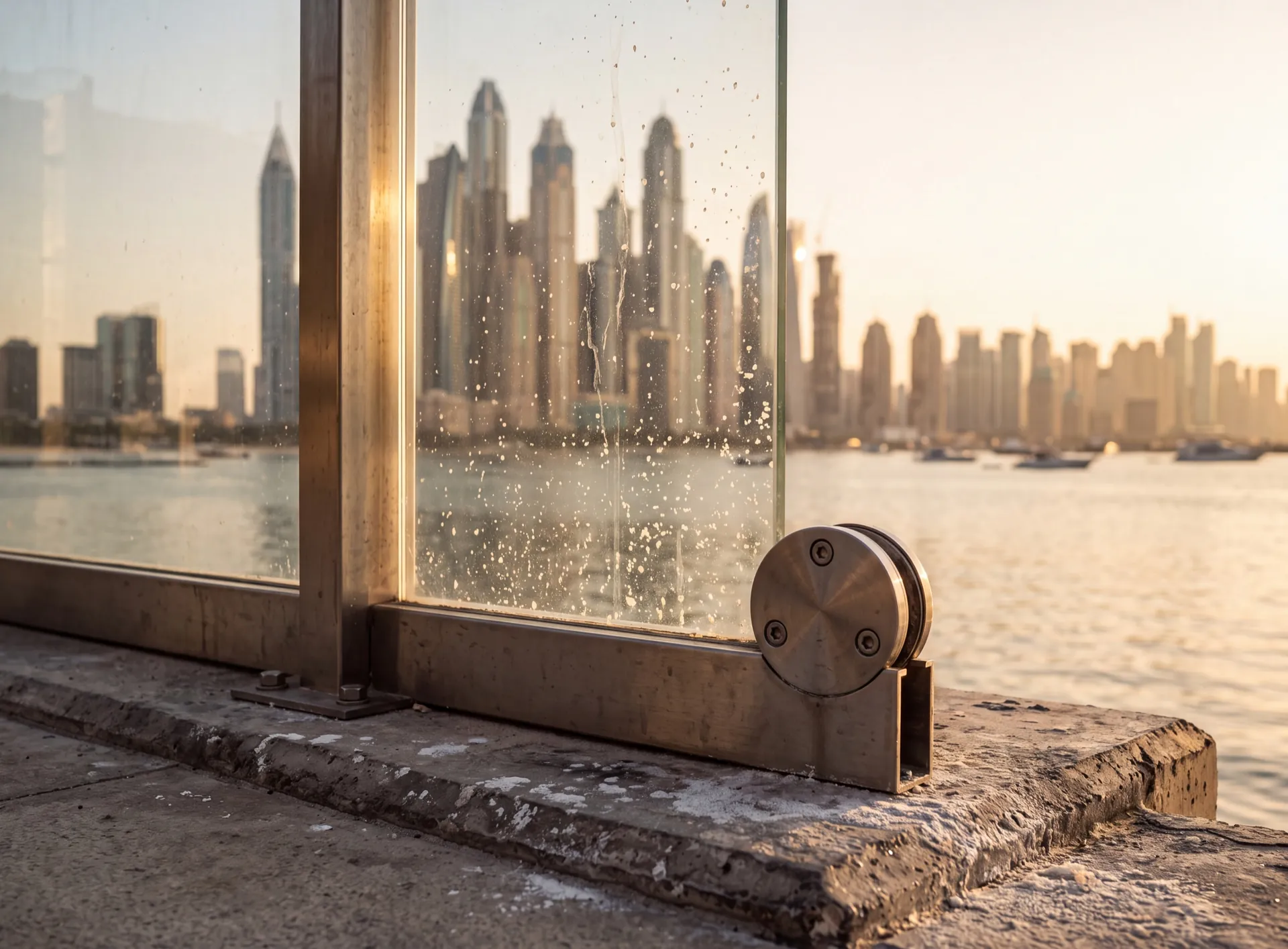
Three things are working on a coastal balustrade at once: chloride from sea air, condensation that forms overnight and dissolves that salt into a corrosive film, and ultraviolet that degrades anything organic — gaskets, sealants, coatings. They are slow and cumulative, and the routine that beats them is genuinely simple.
Why fittings stain, and what tea-staining is
The brown speckling that appears on seafront stainless is called tea-staining, and it is not rust in the way that steel rusts. Stainless protects itself with a passive chromium oxide film; chlorides attack that film locally, and where it breaks down the iron underneath discolours. The result is cosmetic at first and progressive if ignored.
The main cause is grade. The common stainless grade performs well inland and struggles in salt-laden air. A higher-molybdenum marine grade resists chloride attack far better and is the right specification anywhere within reach of sea spray — which on this coast is further inland than people assume, because the air carries it.
The second cause is finish. A smoother, well-polished surface holds less salt and cleans more easily; a coarse or scratched finish gives chloride somewhere to sit. This is why a scratch from a ladder or a badly cleaned weld often becomes the first place staining appears.
The rinsing routine
Fresh water, regularly. That is most of it. Rinsing removes the salt film before overnight condensation turns it into an electrolyte sitting on the metal, and doing it often enough matters more than doing it thoroughly.
For a seafront property, every couple of weeks is a reasonable interval, and after any storm or unusually windy period it is worth doing regardless of schedule. Further from the water, monthly is generally enough.
Use mild soapy water and a soft cloth or sponge, then rinse and dry with a clean cloth. On stainless, work along the grain of the finish rather than across it. What to avoid: steel wool and wire brushes, which embed particles that then rust; chlorine-based bleach cleaners, which attack the passive layer directly; and abrasive pads that scratch the surface into a shape that holds salt.
Where light tea-staining has already appeared, a proprietary stainless cleaner will usually take it off and restore the surface. It is worth doing early — the longer it sits, the more likely it is to have started pitting underneath.
The glass, and why it streaks
Glass is chemically unbothered by salt, but salt spray dries into deposits that are harder to remove than dust, and if they are left through repeated wet-dry cycles they can etch the surface over time. That is what the permanent-looking haze on old seafront glass usually is.
Rinse first with plain water to carry the salt off, then clean. Going straight in with a cloth grinds the crystals across the surface. A squeegee and a final dry with a microfibre cloth prevent the streaking that makes clean glass look dirty in low sun.
Hard water leaves its own marks here, so drying rather than air-drying is worth the extra minute. For balustrades in permanent spray, some owners have a protective coating applied to the glass, which makes deposits easier to remove — it wears and needs renewing, but it reduces the effort noticeably.
The parts to look at once a year
The base. Where a spigot or channel meets the slab is where water sits, and it is where fixings corrode out of sight. Look for staining running down from a fixing, a spigot that has begun to move, or sealant that has cracked and is holding water rather than shedding it.
The gaskets and setting blocks inside a channel or spigot. These are consumables and they harden in ultraviolet. A panel that has developed a slight movement at the base is usually reporting this rather than anything structural, but it should not be left, because a moving panel works on its fixings.
Welds and cut ends on any steel or aluminium element. These are where a protective coating is thinnest or was applied last, and they are the first place to show trouble.
And the handrail joints, which collect water and are frequently the point where a run of balustrade starts to look tired while the panels still look new.
What to specify if you are replacing
Marine-grade stainless for anything within reach of spray, and be sceptical of a quote that does not state the grade at all. It is a real cost difference and it is the difference between annual cleaning and annual disappointment.
For aluminium, a coating system specified for coastal exposure and — more importantly — proper pretreatment underneath it. Ask what happens to cut edges and drilled holes on site, because that is where a good coating is defeated by poor practice.
And consider access at the design stage. A balustrade that can be rinsed easily from the terrace will be rinsed; one that requires reaching over a drop will not be, whatever anybody intends. On a coastal property, ease of cleaning is a specification decision rather than an afterthought.
Rinse with fresh water more often than feels necessary, dry rather than let it air-dry, and never use anything abrasive or chlorine-based on stainless. Then check the base fixings once a year — that single inspection catches the only failure on this list that matters structurally.