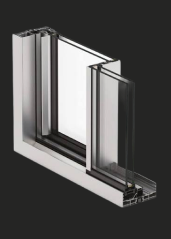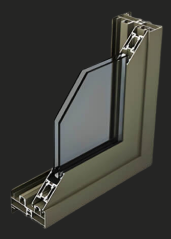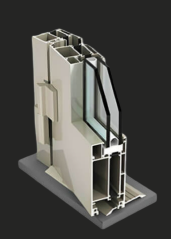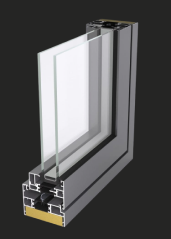


Both types share the same three components: a motor, a guide the leaf runs on, and a control unit. What separates them is the input. A motorized door is triggered deliberately — a button, a remote, a switch behind a reception desk, an access card. An automatic door is triggered by detection, which means it opens for anyone who walks toward it, and that shift is what brings the safety requirements with it.
How the drive is actually built
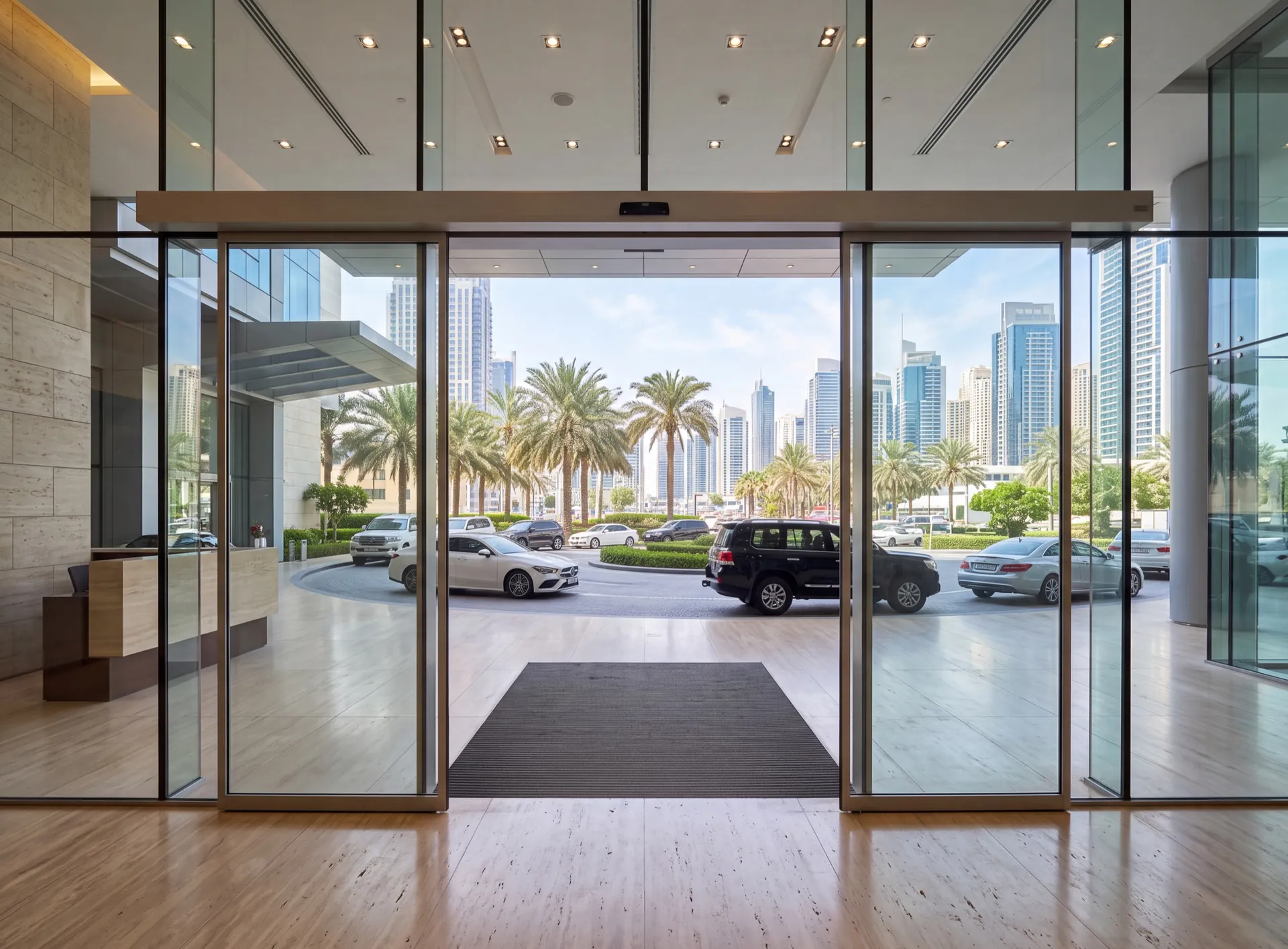
On a sliding entrance, the visible bar above the opening is the operator. Inside it sit the motor, a toothed belt running the length of the beam, the carriages that carry the leaves, and the controller. The leaves hang from that beam and are guided at the floor rather than carried there, which is why a good automatic entrance has no upstand to trip over.
On a swing door, the operator is a smaller unit at the head of the frame driving an arm. It is less obtrusive but does more work, because it has to control a leaf that swings into a space where people might be standing.
Either way, the thing that determines whether the installation feels good is the beam and its fixing. An operator carrying two glass leaves is heavy and precise, and it needs a structural head to hang from. Where the head is not structural, it has to be made structural first — a step that has to be identified before the order rather than on installation day.
The sensors, and what each one is for
Activation sensors sit above the opening and look outward, usually radar-based, detecting movement approaching the door. They are what makes the door automatic, and their zone is adjustable — set too wide, the door opens for people walking past, which wastes cooled air all day.
Presence or safety sensors look downward into the doorway itself and hold the door open while somebody is in it. These are not optional. Without them, a door that has begun to close has no way of knowing that a person is still standing in the opening.
Photocells across the threshold are the third layer, and on swing doors a low-energy setting limits force and speed so an unexpected contact is a nudge rather than an impact.
The distinction matters commercially. Activation sensors are a convenience and can be tuned to taste. Presence sensors are a safety function, and any quote that treats them as an upgrade line is quoting the wrong thing.
Where each type belongs
Automatic doors belong where the traffic is public and continuous: an office lobby, a clinic, a retail entrance, a hotel. Hands are full, people arrive in groups, and nobody should have to touch the door. In this climate they also cut the time the entrance stands open, which matters more here than in a temperate country — a door that closes immediately behind each person keeps a lobby cool.
Motorized doors belong where the movement is heavy but occasional and controlled: a large lift-and-slide door onto a terrace, a wide entrance opened once in the morning, a gate. The operator does the lifting; a person decides when. There is no reason for a villa terrace door to open at anyone who walks near it.
The hybrid case is common and worth naming: an entrance that is automatic during business hours and switches to card-controlled or manual outside them. That is a controller setting rather than different hardware, and it is worth asking for at the specification stage.
What to check before ordering
What happens in a power cut. A public entrance normally has to be openable by hand without tools, either by a break-out function or a manual release, and the answer should be in the specification rather than discovered later.
How the door behaves on fire alarm, since in many buildings automatic entrances are required to open and stay open. That is a matter for the building's fire strategy and it should be confirmed rather than assumed.
The structural head, as above, and the floor. A sliding entrance needs a flat, level threshold along the whole travel — a floor that falls slightly across the opening shows up as a leaf that drags at one end.
And the environment, which here means blown dust. The bottom guide of a sliding automatic door collects it exactly like a domestic sliding door does, and a public entrance sees far more traffic. A maintenance interval agreed at the point of sale is worth more than the warranty clause that follows it.
If the door must open for people who did not ask it to, it is automatic and it needs presence sensing as a matter of safety, not specification. If it opens when somebody decides it should, it is motorized, and the conversation is about the drive and the guide rather than about sensors.