

A short version: backlit mirrors are the default in new bathrooms, custom shapes have replaced rectangles wherever the budget allows, antique and bronzed finishes are being used as a warm alternative to plain silver, and full-wall panels are doing the job that lighting cannot in deep apartments. Each has a practical catch worth knowing before ordering.
Backlit and integrated lighting
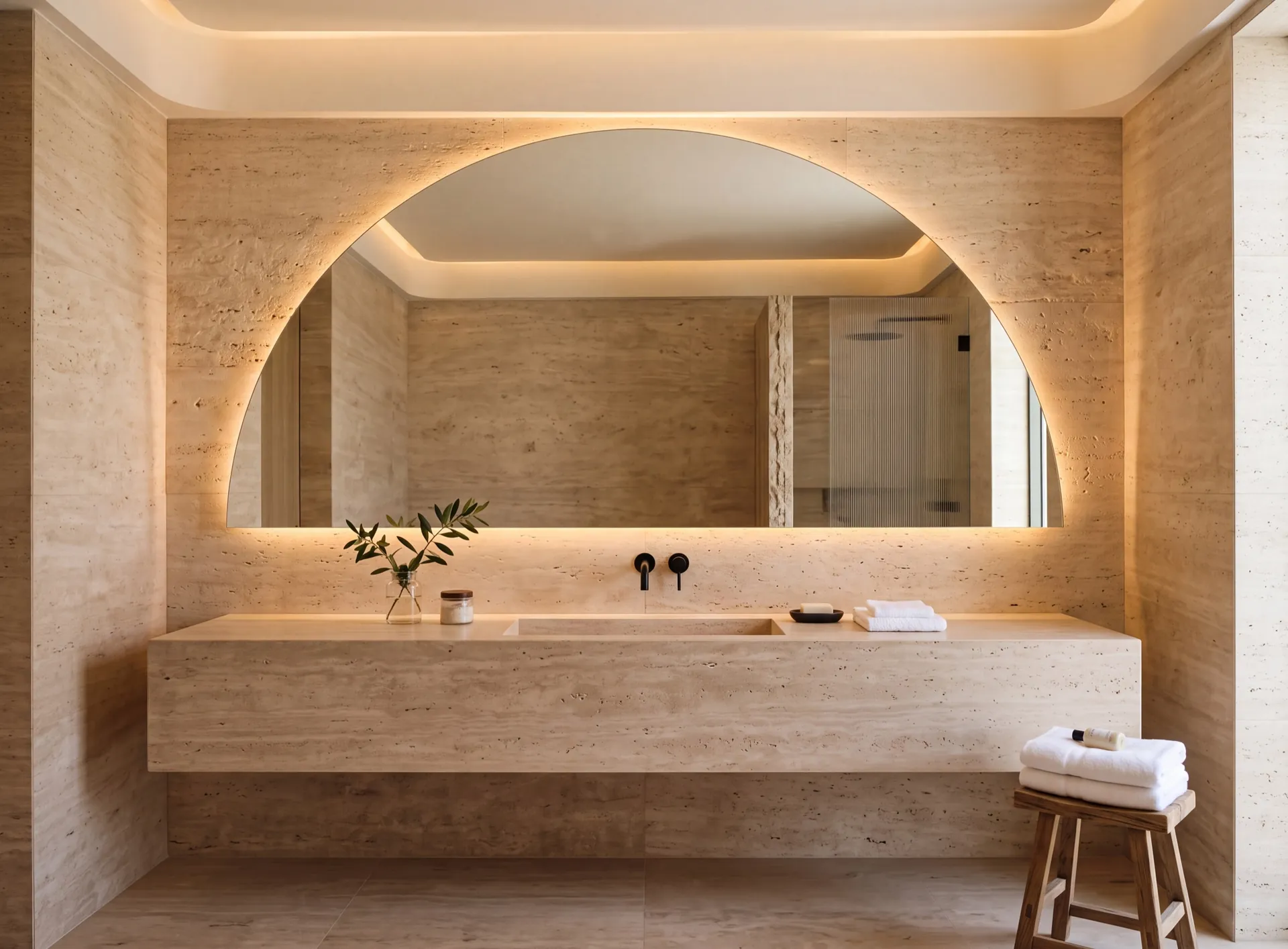
A concealed strip behind the mirror throws light onto the wall around it, so the mirror appears to float and the room gains a soft, indirect glow. It has become the standard in new bathrooms here for a good reason: it is flattering, it works as night lighting on its own, and it removes the need for a separate fitting above the glass.
The important distinction is between backlighting and front lighting. Backlighting is atmosphere; it does not put light on your face. For shaving or makeup you need light coming from the front, which means either a lit band on the face of the mirror or fittings either side. The best installations do both and switch them separately.
The practical requirement is a power supply behind the mirror, which means deciding before the wall is finished. Retrofitting a backlit mirror into a tiled bathroom is possible with surface trunking and it never looks as good. If there is any chance of wanting one, run the cable while the wall is open.
Custom shapes
Arches, soft-cornered rectangles, asymmetric sweeps and compositions of several small mirrors have largely replaced the plain rectangle in the homes being finished now. The arch in particular has become a signature of the current Dubai interior, and it works because it softens a room full of straight lines.
A shaped mirror is cut and polished to order, so the constraint is not the shape but the edge. A curve has to be ground and polished as carefully as a straight edge, and a cheap job shows as a wavy reflection along the boundary. When comparing quotes, this is the detail worth asking about.
Scale is the other trap. A shape that looks striking in a photograph of a large bathroom can overwhelm a small one, and a mirror cut to an unusual outline cannot be trimmed later. Mark it out on the wall in tape before confirming the order — it takes five minutes and prevents the most expensive kind of regret.
Antique, bronzed and tinted finishes
Not every mirror needs to be plain silver. Bronze and grey tinted mirror give a warmer, dimmer reflection that sits better against travertine, timber and the sand-coloured palette common in villas here. Antique mirror, with its deliberate mottling, reads as a decorative surface rather than as a functional mirror.
The rule of thumb is to use these where you look at the mirror rather than into it: a dining room wall, a panel behind shelving, a wardrobe front. Keep clear silver where the mirror is doing a job — the bathroom, the dressing area — because a tinted mirror genuinely makes it harder to see what you are doing.
Antique finishes also hide marks well, which makes them a practical choice in a hallway or behind a bar where fingerprints would otherwise be constant.
Full-wall panels
In a deep apartment where daylight arrives from one wall, a mirrored panel on a perpendicular wall does something no light fitting can: it borrows the window. The room reads as twice the size and, more usefully, twice as bright at the back.
The two mistakes are placement and jointing. A mirror facing directly into a window reflects glare rather than view; a mirror set perpendicular to it carries the light deeper. And a large wall cannot usually be one sheet — panels have to be delivered through a lift and a hallway — so the joint pattern should be designed rather than left to the fitter.
Fixing matters more here than for a small mirror. A full-height panel is heavy, and it wants both adhesive and mechanical support unless the wall and the adhesive specification are certain. This is the case where asking how it is held on is entirely reasonable.
The parts of the specification people skip
In a bathroom, ask for a moisture-resistant backing. Ordinary mirror backing degrades where steam reaches the edges, and the black creep along the border of an old bathroom mirror is exactly that failure.
For any mirror above head height, or in a room used by children, laminated or safety-backed mirror is worth specifying: a backing film holds the pieces together if the glass is ever broken.
And confirm the edge treatment — polished, bevelled or hidden behind a frame. It is a small line in a quote that makes a visible difference on a frameless mirror, which is most of them now.
Decide what the mirror is for before choosing how it looks. If you use it to see yourself, keep the glass clear and put light on the front; if it is there to open up a room or warm a wall, that is where shapes, tints and full panels earn their place.