


Almost every avoidable window fault on this coast comes down to one of three things: sand left where it can grind, water left where it can stand, or a cleaning method that took the finish off. Getting those right is the whole of ordinary maintenance.
Start where nobody looks: the drainage slots
Along the bottom of every frame is a set of small openings that let water out of the rebate — the channel where the glazing unit sits. They are the most important part of the window to keep clear and the part nobody has ever been shown. Fine dust settles into them, the first rain turns it to a paste, and after a season they are closed.
Once they are blocked, water stands in the rebate against the edge of the glazing unit instead of running away. Standing water is what shortens the life of an edge seal, and it is what starts corrosion at fixings and at any cut edge in the coating. A blocked slot is therefore not a housekeeping detail; it is the mechanism behind a good share of the failures that eventually get called old windows.
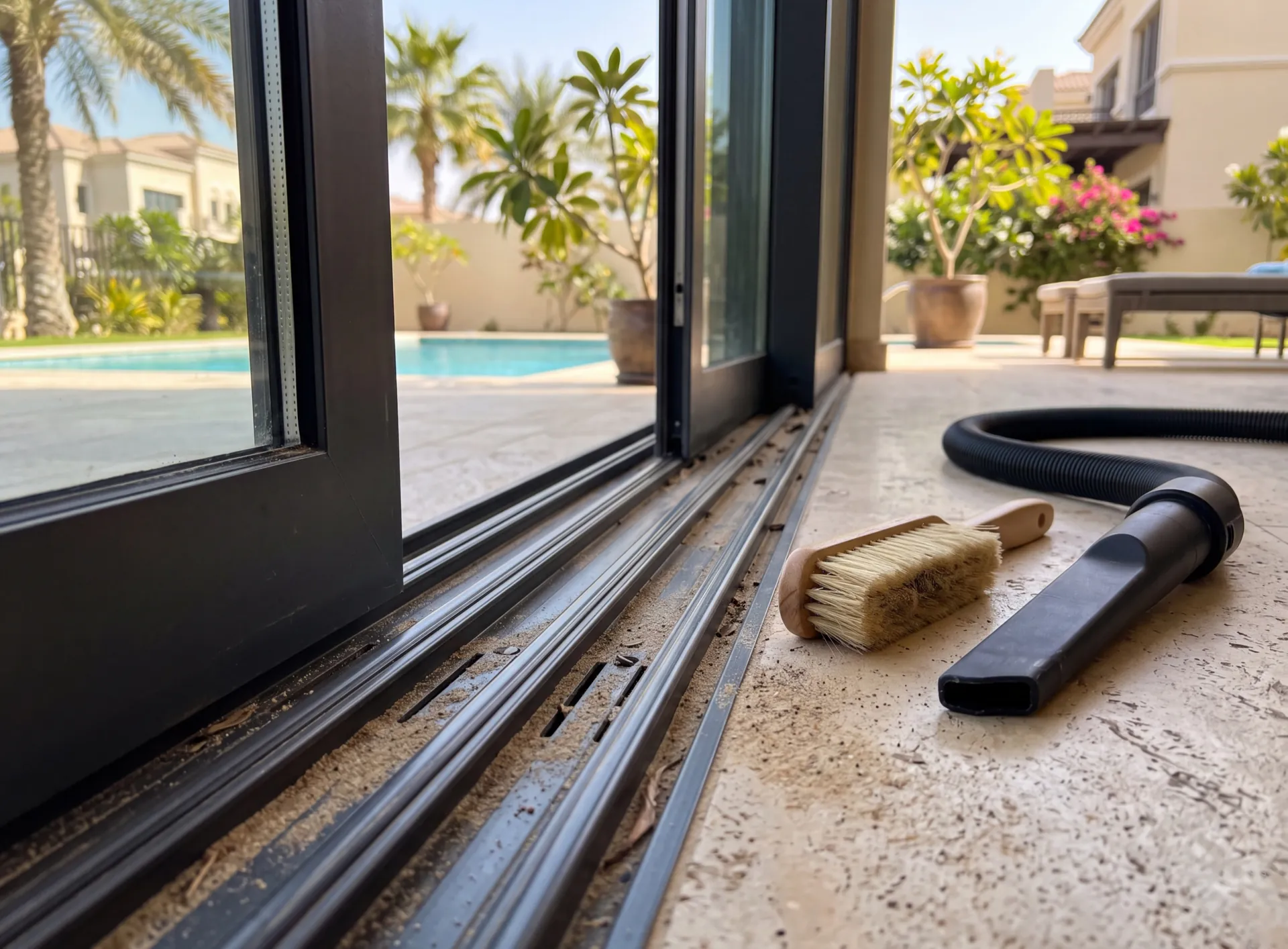
Clearing them takes a soft brush and a vacuum nozzle: brush the loosened dust towards the openings, draw it out, then pour a little water along the rebate and watch that it runs. Nothing rigid goes into the slot — a screwdriver or a wire scratches the coating exactly where water sits, which creates the next problem. Doing this twice a year, and again after any serious storm, is the single highest-value maintenance habit there is.
Tracks and rollers, and why grease makes it worse
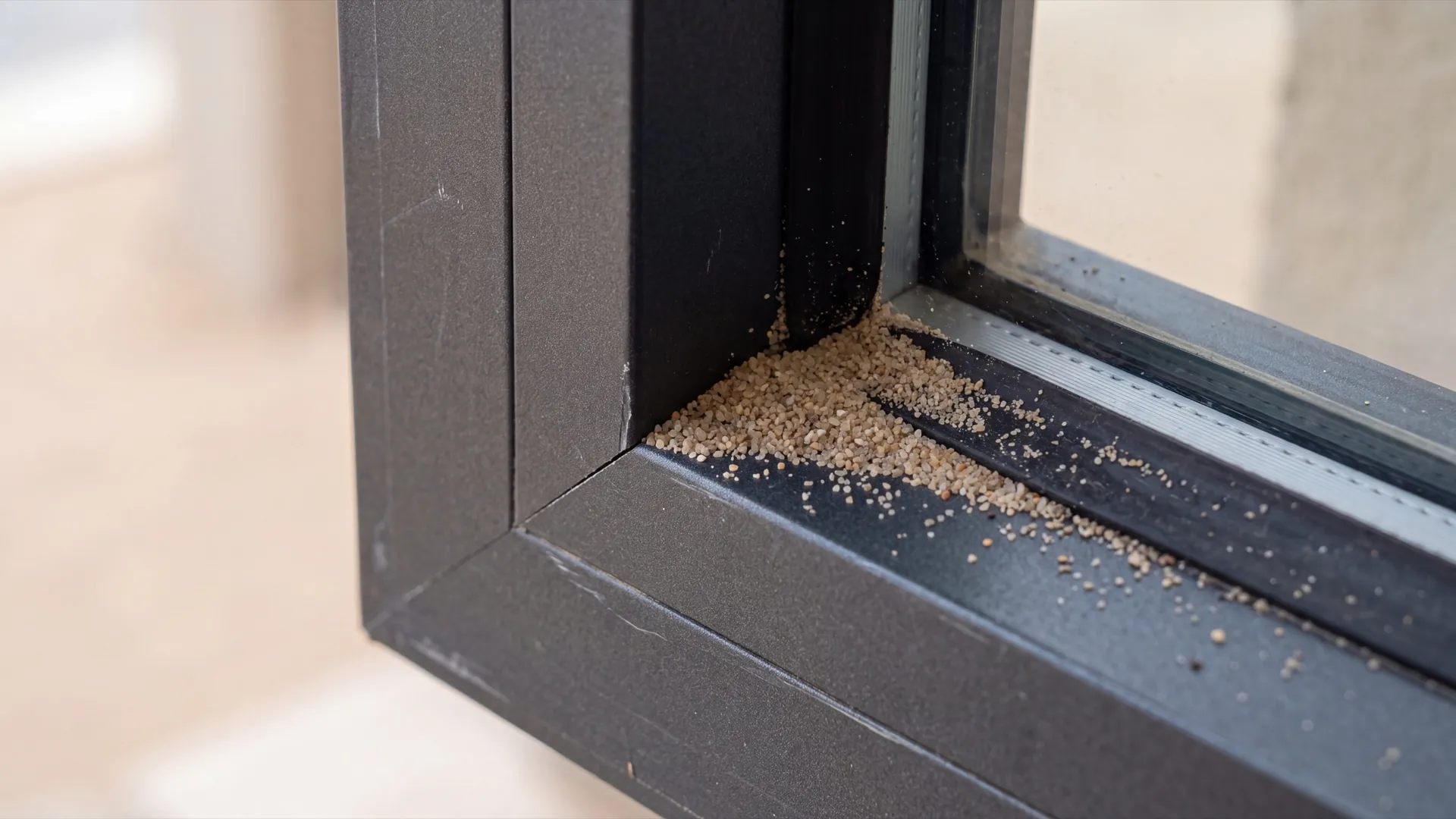
The bottom track of a sliding door is a trap for everything the wind brings in, and the rollers then run over it. Sand under a wheel is an abrasive between two hard surfaces, so a track left dirty wears both the running surface and the rollers, and the door gets heavier month by month until somebody starts putting a shoulder into it.
Cleaning is a vacuum along the channel first, then a damp cloth or a narrow brush to lift what is stuck, then dry. What matters is that the vacuum comes before the cloth: wiping a dry, sandy track simply drags the grit along the metal. Where the track has corners or a threshold junction, that is where the drift builds first and where the brush is needed.
The instinct after cleaning is to grease the track, and it is the wrong instinct. Grease and oil hold sand in place and build a paste that is far more abrasive than a dry channel, so a greased door runs beautifully for a fortnight and badly for the rest of the year. Where the hardware maker calls for lubrication it is on the rollers and the locking gear, with a dry or silicone-based product applied sparingly, not on the running surface. And a leaf that has become genuinely hard to move should be looked at rather than forced, because by that point something is usually worn rather than dirty.
Washing glass and frames without damaging either
The frames should be washed at the same time as the glass, and on a seaward elevation that matters more than the glass does. Rinse first with plenty of clean water so the layer of dust floats off, then wash with a mild detergent and a soft cloth or sponge, then rinse again and let it dry. The rinse before the wipe is the part people skip, and it is the part that stops the sand on the surface being used as a polishing compound on the coating.
The list of things to keep away from a window is short and worth knowing. No blades, scrapers or abrasive pads — they cut the coating and they damage the seal along the edge of the glazing unit. No solvents, acidic or strongly alkaline cleaners, or anything sold to remove cement — these attack coatings and anodised surfaces. No high-pressure jet aimed at the perimeter joint or at the gaskets, because pressure drives water past seals that were designed to shed it, not to resist a lance.
Where the property is near the shoreline, add a plain fresh-water rinse of the frames and hardware into the routine even when nothing looks dirty. Salt that has settled and dried is doing its work invisibly, and rinsing it off is the cheapest corrosion protection available.
Gaskets: clean them, do not dress them
The rubber seals around each sash are what keep dust, noise and humid air out of the room, and they only work while they still press evenly against the frame. They are cleaned with water and a soft cloth as part of the ordinary wash. What they do not want is oil, silicone spray or anything sold as a rubber dressing, which softens some compounds and leaves a tacky film that collects sand on precisely the surface that has to stay clean to seal.
Twice a year it is worth running a finger along them and looking at two things: whether the rubber has hardened or shrunk back at the corners, leaving a gap where two lengths meet, and whether it has been ground flat anywhere along its length by grit. Both are normal wear on an exposed elevation, and both are cured by replacing the gasket rather than by replacing anything larger.
A simple test of whether the sash still seals: close it on a sheet of paper and pull. If the paper slides out easily at one point and grips at another, the closing pressure is uneven, which is a hinge or a keep adjustment rather than a seal problem. That is worth booking rather than living with, because a sash that no longer presses evenly is letting humid outside air straight into a cooled room.
Handles, hinges and locks
Hardware asks for very little: a wipe, a check that the fixing screws are snug rather than tight, and a small amount of the lubricant the maker specifies on the moving parts of the locking gear. Over-tightening a handle screw into an aluminium section strips the thread, which turns a two-minute job into a repair, so snug is the word.
Most complaints about hardware are really complaints about adjustment. A handle that has become stiff, a lock that needs the sash lifted before it will engage, a leaf that catches at one corner — these are usually the sash sitting a few millimetres out of position rather than a failing component, and they are corrected on the hinges and keeps in minutes. Forcing them instead is what turns an adjustment into a broken part.
On coastal properties the fittings are the first casualty of salt air, particularly at screws and at any steel component. Rinsing them with fresh water during the ordinary wash, and looking once a year for rust bleeding from a fixing, catches that early enough for a fitting to be swapped rather than a sash to be rebuilt.
After a storm, and a rhythm worth keeping
The morning after a shamal, resist the urge to wipe. Everything is coated in fine dust, and a dry cloth turns that into an abrasive on the glass and on the frames. Hose or sponge plenty of water on first and let the bulk of it run off, then wash normally. Do the frames as well as the glass, and do the horizontal surfaces where the drift has collected.
Then repeat the two jobs from the start of this article, because a storm undoes both of them at once: vacuum the tracks and clear the drainage slots. Sliding doors and any window that was open during the blow will have taken the most, and a balcony or terrace elevation will have taken more than a courtyard one.
A rhythm rather than a schedule is enough for most properties. A quick wash and a look at the tracks every month or two; the full routine — drainage, tracks, gaskets, hardware, frames — before and after the season when storms are likely; and, on an exposed or seaward elevation, a professional service where the hardware is adjusted, the closing pressure reset and worn gaskets and rollers replaced before they start doing damage to something larger.

Keep the water moving and the sand out of the moving parts, and aluminium windows here will outlast almost everything attached to them. Clear the drainage slots twice a year and after every storm; vacuum tracks before wiping them and keep grease out of them; rinse before you wash and keep blades, solvents and pressure jets away from coatings and seals; wash the frames on a seaward elevation as carefully as the glass. Anything that has become stiff or uneven is an adjustment, and adjustments are cheap right up until somebody forces the sash instead.