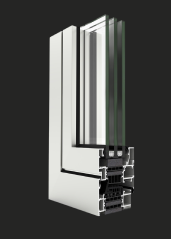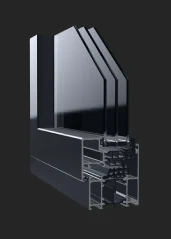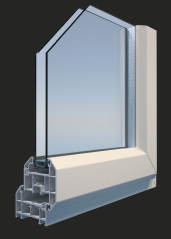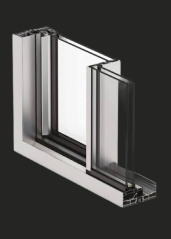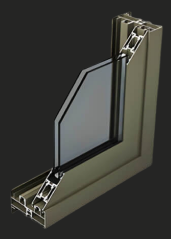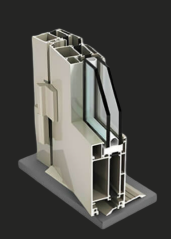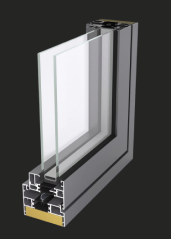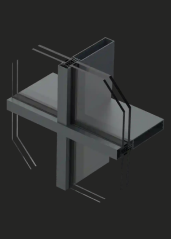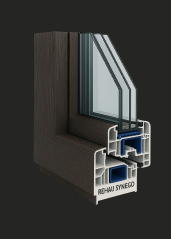


This is a non-insulated system — the section has no thermal break — and that single fact decides where the door belongs. We fabricate Schüco profiles to the manufacturer's specification at our Dubai factory and install them ourselves.
Where a non-insulated folding door belongs
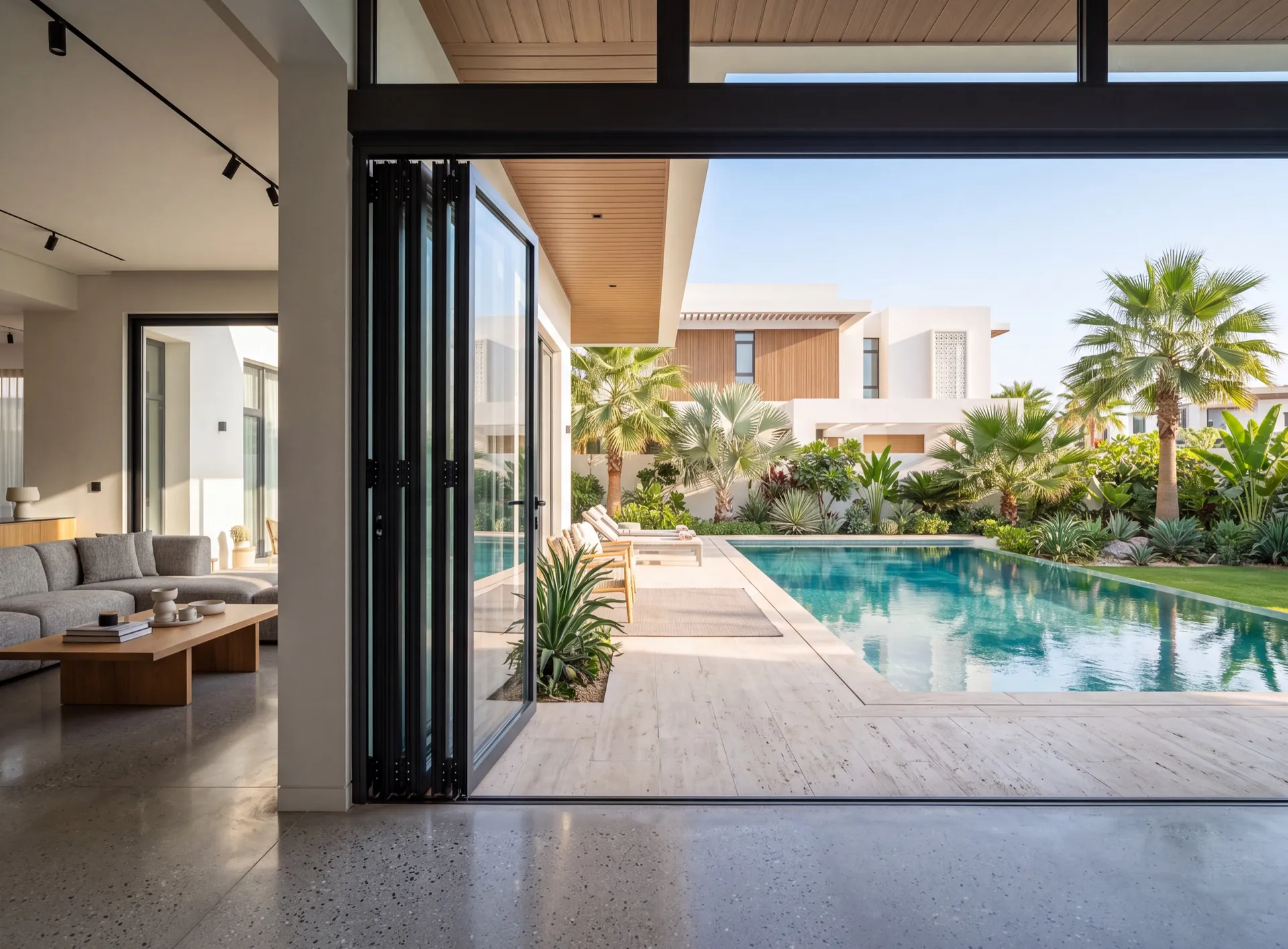
Openings between the outside and a space that is itself open or only lightly cooled: a restaurant or café front that folds away in the evening, a covered terrace closed against wind and sand, a pool house, a garden pavilion. Here the door is a screen against wind, dust and noise rather than a thermal barrier, and a full-width opening in the cooler months is the whole point. The integrated side-hung door option lets people walk through without folding the whole run.
What the figures mean
Vents up to 1500 mm wide and up to 150 kg with glazing up to 50 mm: enough for toughened or laminated safety glass with a solar-control coating. The interlock, from 90 mm, is where the leaves meet and fold, and it shows when the run is closed.
Without a thermal break the aluminium carries outside heat straight to the inside face. Next to an air-conditioned room in summer that means a warm frame and extra cooling load, and on humid coastal nights a cooled frame can collect condensation on its outer face.
AS FD 75.NI or the insulated Schüco sliders
The Schüco sliding systems here are all thermally insulated: ASE 60 with Uw from 1.1 W/(m²·K) and vents up to 3500 mm and 500 kg, ASS 50 with Uw from 1.9 W/(m²·K), ASS 77 PD.HI with Uw from 1 W/(m²·K). None of them folds away completely, but each belongs between an air-conditioned room and the outside. AS FD 75.NI is the one for a full opening where cooling is not the priority.
AS FD 75.NI is a folding door for spaces that open to the air, not for sealing an air-conditioned living room through a Dubai summer.