


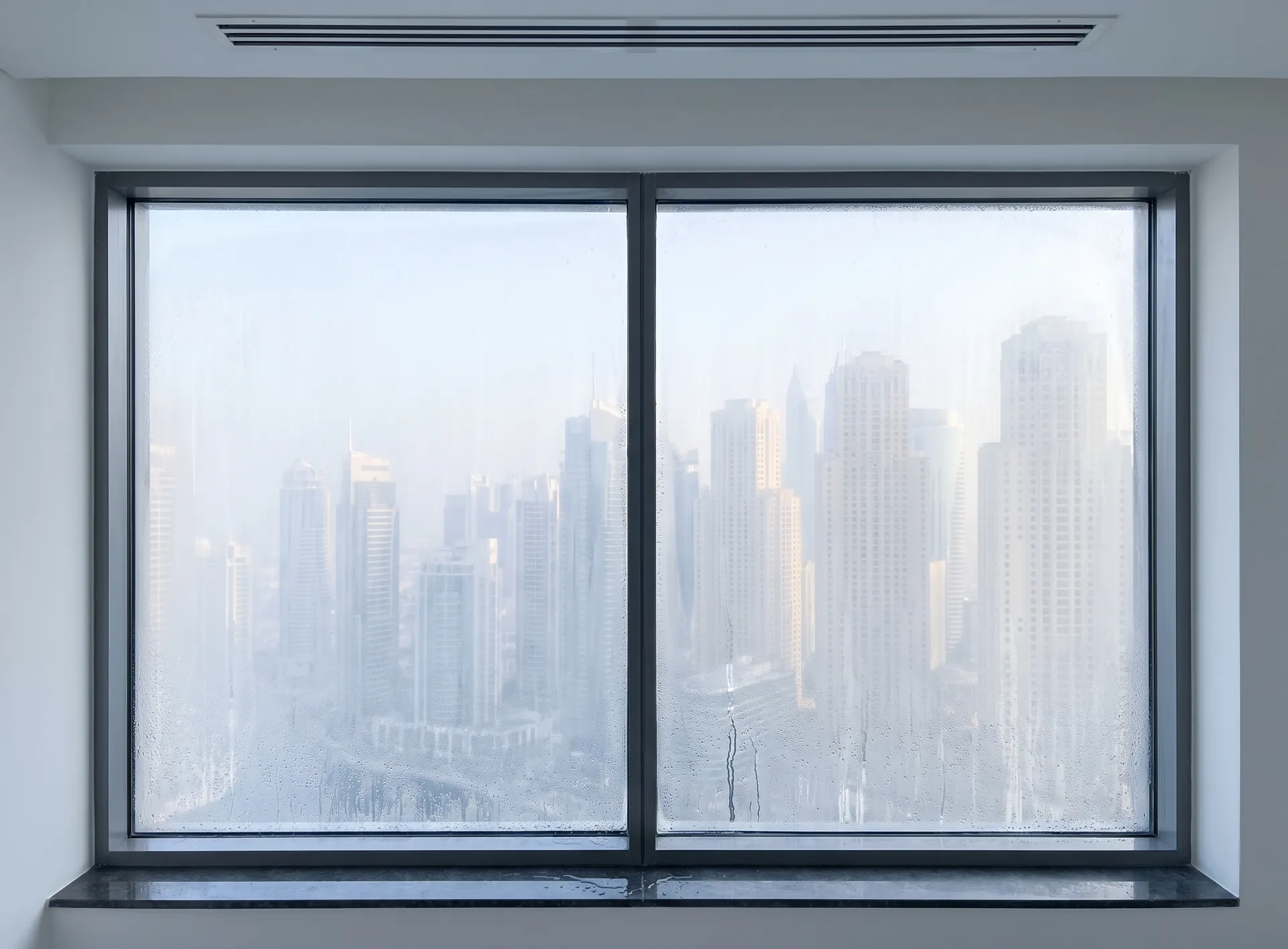


Water on a window is not a single fault with a single cause. It can sit on the room side, on the weather side, or sealed away between the two panes where nothing can reach it, and each of those is telling you something else. Start by finding out which one you have.
First: which side of the glass is it on?
Run a finger down the pane. If the water wipes away, it is on the room side, and it is moisture out of the air in the flat landing on a cold surface — a matter of humidity and temperature rather than a broken window. If the haze stays exactly where it was and the glass feels dry, it is sealed inside the glazing unit, between the panes, and no cloth will ever get to it.
There is a third case worth naming before it frightens anyone. Water on the outside face, on a still and humid morning, is weather doing what weather does to any cool surface — and on a glazing unit it is close to a compliment, because it means the outer pane is running cooler than the air around it instead of passing the day's heat straight into the room.
Everything below follows from that first test. The two real conditions want opposite responses, and treating one as though it were the other is how people end up cleaning a window every morning for a year, or replacing a perfectly good sealed unit because a bathroom has no extractor.
Mist on the room side: humidity meeting something cold
This is dew, forming exactly as it forms on a cold bottle carried out to a terrace. Air carries a certain amount of moisture, and when it touches a surface cold enough it has to give some of it up. In a cooled flat during the humid months the coldest thing in the room is very often the glass, or the metal around it, so that is where the water appears.
Two ingredients have to be present, and both are worth attacking. The first is moisture in the room air: cooking without an extractor, long showers with the door open, laundry drying indoors, a wall of plants, a majlis full of guests. The second is a surface cold enough to catch it, and the usual culprit is an air-conditioning vent aimed straight along the window wall, or a heavy curtain hung tight to the glass that traps a pocket of chilled air against it.
None of that is a fault in the window until it becomes constant. Water standing on the sill morning after morning, soaking into the reveal and eventually marking the plaster or growing mould in the corner, is past housekeeping — at that point either the room is far wetter than it should be, or the window has a cold surface it should not have.
Mist between the panes is a failure, not a nuisance
A sealed unit is two panes held apart by a spacer bar full of a drying agent, with the whole edge sealed so the air shut in the cavity stays dry. When that edge seal lets go, humid outside air starts working its way in, the drying agent fills up and stops taking anything more, and from then on every hot afternoon and every cool night pumps moisture through a cavity that can no longer deal with it. You see it as haze, as droplets that come and go with the sun, and finally as a chalky bloom that stays put.
Nothing applied to either face reaches it, because there is glass on both sides of the problem. The unit is exchanged rather than repaired; the frame, the hardware and the finish stay where they are, so it is a glass job rather than a window job. The drill-a-hole-and-let-it-breathe method sold online turns a sealed unit into an unsealed one — the mist clears, and then the dust arrives and never leaves.
The edge seal is the part under real load in this climate. It works through a wide daily temperature swing that pumps the cavity in and out, in air that is humid for months at a time, with ultraviolet on the sealant anywhere the beading leaves it exposed, and with standing water sitting against it wherever a drainage slot has silted up with sand. That is why misted units turn up here on buildings that would still be perfectly sound somewhere milder.
Why it starts at the edges: the frame and the spacer
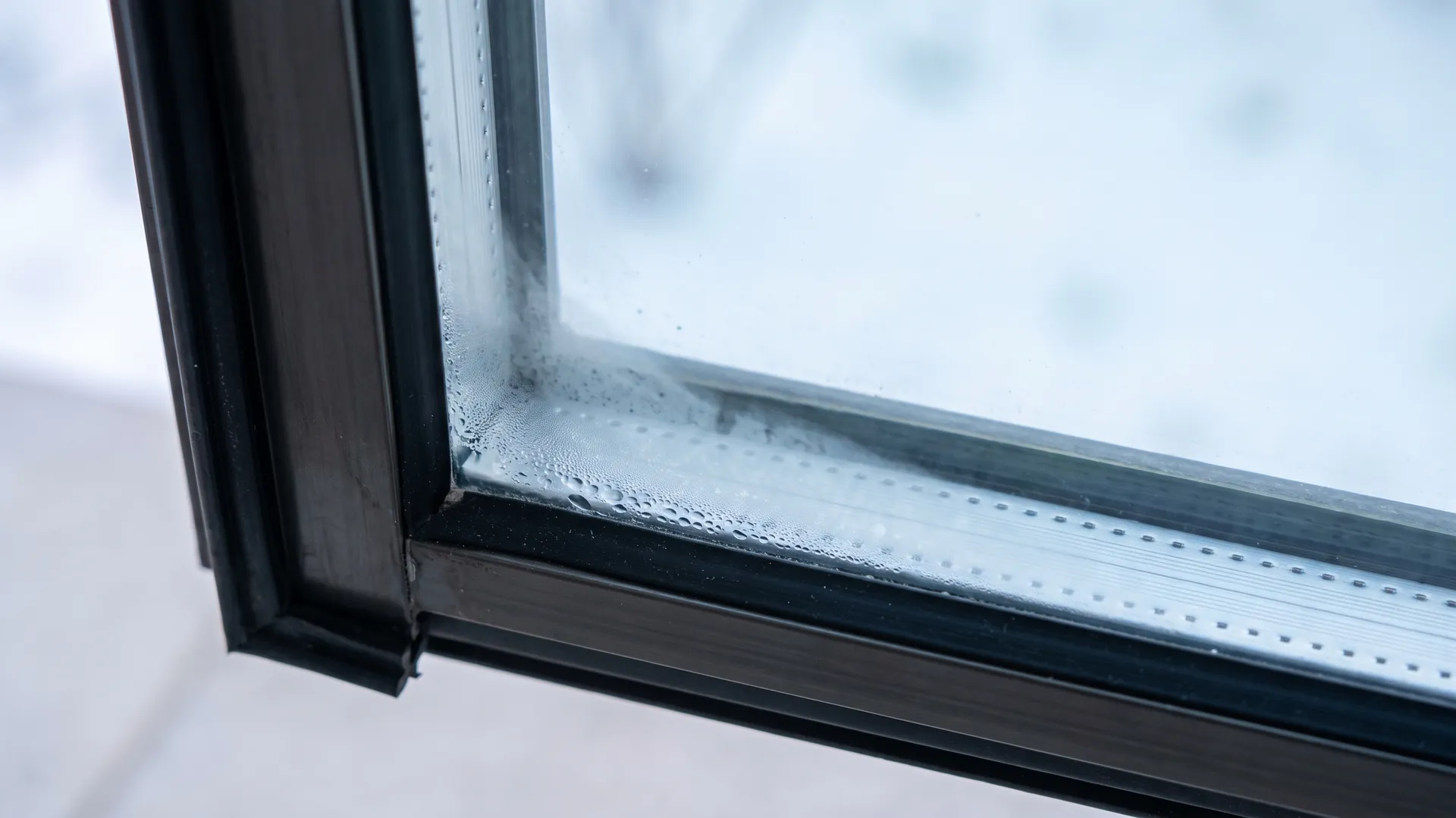
Condensation always begins on the coldest patch available, and on a window that is almost never the middle of the pane. It is the perimeter of the glazing unit and the metal around it, which is why the fog usually appears as a band round the edge of the glass and as beads along the frame while the centre of the same window stays clear.
Aluminium moves heat readily in both directions. In a flat that is cooled hard, an unbroken profile carries that cold right through the section — out into the rebate, the drainage channels and the outer face, where hot damp air is waiting for it — and the water that forms there collects in the frame and eventually finds its way to the sill. A thermal break is an insulating bar between the outer and inner halves of the profile, and it keeps the two temperatures from dragging each other about.
The glazing unit has the same weakness in miniature. Its coldest strip is the edge, where the spacer bar bridges the two panes, and a plain metal spacer conducts straight across that joint. A warm-edge spacer is made of a material that does not, which lifts the temperature of exactly the band where the misting starts. Neither of these is a luxury item here; they are the difference between a dry sill and a wet one.

What to try yourself, and when to call someone
For room-side misting, work on the two ingredients. Use the extractor while cooking and after showering, and give it a few minutes afterwards rather than switching it off at the door. Stop drying laundry in a closed bedroom. Move the air-conditioning louvres so the supply is not playing along the glass. Leave a hand's width between a heavy curtain and the window so the pane is not sitting in its own cold pocket. And air the flat properly when the weather allows it, because a room that is never opened will always find a cold surface eventually.
One job is worth doing whatever the cause: clear the drainage slots along the bottom of the frame. They fill with fine sand, water then stands in the rebate against the edge of the glazing unit, and standing water is the single most reliable way to shorten the life of an edge seal. A soft brush and a vacuum nozzle are the whole toolkit.
Call a fitter when the haze will not wipe off, when a whole elevation is wet rather than one window, when water is still standing in the frame after the drainage has been cleared, or when a sash no longer presses evenly against its gasket — because a window that has stopped sealing is letting humid outside air straight into the room, and no amount of extractor fan will keep up with that. On the windows we manufactured and installed, an engineer can be with you within 48 hours to say which of those it is.
The finger test does most of the diagnosis: wipeable water is about the air in the room and the temperature of the surface it lands on, and it responds to ventilation, to where the cooling is pointed and to a warmer frame and spacer. Mist that will not wipe is a sealed unit at the end of its life, and it is glass that gets replaced rather than a window — provided the drainage has been kept clear and the frame is still doing its job.