

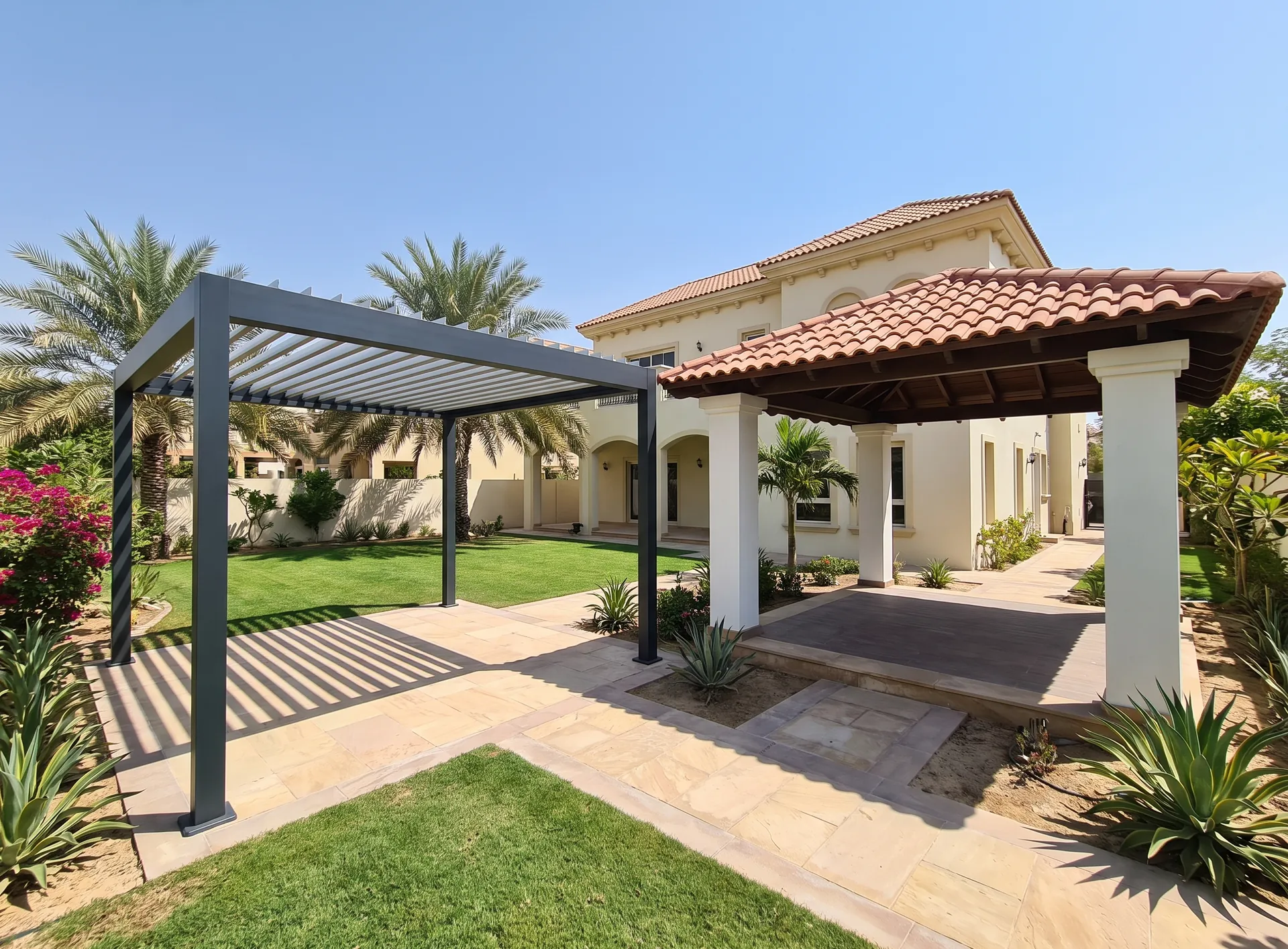
In short: a gazebo is a freestanding structure with a solid roof and often a raised floor, usually square or octagonal, read as a small pavilion. A pergola is a frame with an open roof — beams, fixed slats or rotating blades — attached to the house or standing alone. Both give shade. Only one of them lets hot air out of the top.
The structural difference in one paragraph
A gazebo carries a roof that sheds water, so it needs a pitch, a covering and a structure sized for that load. It usually reads as a separate object in the garden, sited away from the house, and it often comes with its own floor.
A pergola carries a roof that manages light rather than water — unless it is the bioclimatic kind, whose blades close into a sealed surface. It is commonly attached to the villa and treated as an extension of the terrace rather than a destination in the garden.
That siting difference matters more than it sounds. A gazebo you walk to; a pergola you step onto from the living room. In practice the second gets used far more often, because the barrier to going outside is a door rather than a decision.
Heat, and why the open roof wins here
Under a solid roof in summer, hot air collects and stays. The covering absorbs sun all day, radiates it downward, and with walls or a low soffit there is nothing to carry that heat away. A gazebo that felt delightful in a European garden can be noticeably worse than standing in the shade of a wall here.
An open or louvered roof does the opposite. Rising hot air escapes between the blades and moves through, so the space under it stays closer to the ambient temperature. On a still day the difference is modest; on any day with a breeze it is substantial, and the breeze is the resource this coast actually has.
This is the argument for adjustable blades in particular. You can close them against the low afternoon sun and still leave enough gap for air to move, which is a combination a fixed roof cannot offer at any price.
Sand, salt and what you will be cleaning
After a windy few days, everything outdoors here carries a film of fine dust, and the question is how easily it comes off. Powder-coated aluminium is rinsed down and done. Timber — the traditional gazebo material — holds dust in the grain, and the finish that protects it from ultraviolet has to be renewed on a schedule that people rarely keep.
Salt air adds the second problem. Untreated steel fixings corrode, and timber near the coast moves and cracks faster than the same timber inland. This is where an aluminium structure with stainless fittings stops being a style preference and becomes the low-maintenance answer.
None of this rules out a timber gazebo. It says that the honest comparison is not purchase price against purchase price, but purchase price plus the hours and money the structure will ask for every year afterwards.
When a gazebo is the right answer
When the point is a destination rather than an extension. A shaded spot at the end of a large garden, a poolside pavilion, a covered outdoor dining room away from the house — a gazebo does that, and a pergola attached to a wall cannot.
When rain protection has to be absolute and cost has to be low. A solid roof keeps everything under it dry without any moving parts, which a non-bioclimatic pergola will not do.
And when the look is the requirement. A gazebo carries an architectural presence that a slim frame does not, and in a garden designed around it, that presence is the point.
And when the answer is neither
If the real wish is an air-conditioned space usable in July, neither structure delivers it. Both are shade, and shade in the height of summer here means a space that is tolerable in the evening rather than comfortable at noon. The product for that requirement is a glass room — an enclosed, glazed extension that can be cooled — and it is a different purchase with a different budget.
It is worth naming this before ordering, because the disappointment is common and entirely avoidable. A pergola bought in the expectation of a summer room will be judged a failure at doing something it was never built to do.
For a terrace off the house that should be usable most of the year, a pergola — ideally with adjustable blades — is the better fit here, because it manages sun without trapping heat. For a shaded destination further down the garden, or where a solid roof is non-negotiable, a gazebo earns its place.